FAIR USE NOTICE

FAIR USE NOTICE

A BEAR MARKET ECONOMICS BLOG

OCCUPY POLITICALLY

This site may contain copyrighted material the use of which has not always been specifically authorized by the copyright owner. We are making such material available in an effort to advance understanding of environmental, political, human rights, economic, democracy, scientific, and social justice issues, etc. we believe this constitutes a ‘fair use’ of any such copyrighted material as provided for in section 107 of the US Copyright Law.

In accordance with Title 17 U.S.C. Section 107, the material on this site is distributed without profit to those who have expressed a prior interest in receiving the included information for research and educational purposes. For more information go to: http://www.law.cornell.edu/uscode/17/107.shtml

If you wish to use copyrighted material from this site for purposes of your own that go beyond ‘fair use’, you must obtain permission from the copyright owner.

FAIR USE NOTICE FAIR USE NOTICE: This page may contain copyrighted material the use of which has not been specifically authorized by the copyright owner. This website distributes this material without profit to those who have expressed a prior interest in receiving the included information for scientific, research and educational purposes. We believe this constitutes a fair use of any such copyrighted material as provided for in 17 U.S.C § 107.

Read more at: http://www.etupdates.com/fair-use-notice/#.UpzWQRL3l5M | ET. Updates
FAIR USE NOTICE FAIR USE NOTICE: This page may contain copyrighted material the use of which has not been specifically authorized by the copyright owner. This website distributes this material without profit to those who have expressed a prior interest in receiving the included information for scientific, research and educational purposes. We believe this constitutes a fair use of any such copyrighted material as provided for in 17 U.S.C § 107.

Read more at: http://www.etupdates.com/fair-use-notice/#.UpzWQRL3l5M | ET. Updates

All Blogs licensed under Creative Commons Attribution 3.0

Creative Commons License
This work is licensed under a Creative Commons Attribution 3.0 Unported License.

Saturday, September 28, 2013

GOP Launches Race War to Boost the 1 Percent


GOP Launches Race War to Boost the 1 Percent


From Newt's epithets to the gutting of food stamps, Republicans try to unite white people to serve a hideous agenda.


The recent vote of House Republicans to cut $40 billion from the food stamp program reflects a deep-seated and insidious racial resentment toward Americans of color. This racial resentment rears its ugly head within the provisions for the bill that demand that non-employed participants in the program get a job, job training or do community service activities. Though the bill in its current form will most likely die in the Senate, the fact that Republicans would even pass it should concern us.

Conservatives continue to lead under the aegis of a deliberate and willful ignorance about the long-term existence of a group known as the working poor, people who work long hours in low-wage paying menial labor jobs, and therefore cannot make ends meet. Moreover, there is a refusal to accept that the economic downturn in 2008 created conditions of long-term unemployment, such that people simply cannot go out and “get a job” just because they will it to be so.

I often wonder if government officials actually talk to real human beings about these policies, because if they did, they would find many people with a deep desire to work, but a struggle to find well-paying jobs. Some of those people would gladly take jobs that pay far less, but are frequently told that their education and years of work experience make them over-qualified.

This is not a race-based problem. The American middle class itself is shrinking dramatically each year in relation to a poor economy, an insistence on austerity measures from the right, and a capitulation to these measures on the left. However, the complete irrationality and utter severity of the legislation, and the total lack of empathy and identification that inform contemporary Republican social advocacy is tied to a narrative about lazy black people and thieving “illegal” brown people.

In 1976, Ronald Reagan invented the term “welfare queen,” to characterize the actions of exactly one person in Chicago who had bilked the welfare system out of a staggering amount of money. Buttressed by an underlying white racial resentment of the liberal pieces of legislation that emerged during the Kennedy and Johnson administrations – laws that had attempted to change conditions, but could not change hearts and minds around racial inequality issues — white conservatives latched on to a narrative about lazy African-Americans stealing from taxpayers and living lavish lives financed by the welfare state.

That narrative has persisted well into the 21st century when Newt Gingrich derisively referred to Barack Obama as the “Food Stamp President” in the 2012 elections. Uninterrogated and misplaced racial resentment has been the most effective strategy for making white people support draconian social policies in the name of “taking the country back.” This is true, even though in sheer numbers, white people are the largest group of recipients of the SNAP program.

Fiscal conservative politicians (including some Democrats like Bill Clinton) have presided over a massive and systematic redistribution of wealth into the 1 percent since the 1980s. For African-Americans this means that we lost over half of our collective (and meager) net wealth, in just the last five years, due to predatory lending and the the machinations of big business. But it is easier to hate and regulate welfare recipients.

Since everyone knows that welfare queens finance their lives of luxury through the receipt of food stamps, which amounts on average to about $135 in groceries each month, cutting the food stamp program, a move that will take nearly 4 million people off the rolls in the next 10 years, is not merely a pragmatic measure or a “necessary evil,” but rather a deeply symbolic act that points to recalcitrant and entrenched racist attitudes on the right. It turns out, then, that African-Americans are not the only group of voters whose political behavior is motivated – at least, in part — by racial identity.
 
The Republican Party often capitalizes on these attitudes about poor African-Americans in moments of economic downturn, as a way to rally white working- and middle-class American voters. This is very similar to the strategy used by the Southern Planter class in the 1850s to curtail alliances between working-class white people and enslaved African-Americans.

Rather than create a more equitable system by freeing the enslaved and paying everyone fair wages, the plantocracy deployed a narrative about white racial superiority that caused poverty-stricken white people to disavow their own class interests in service of racial unity. In fact, as David Roediger outlines in his now classic work “The Wages of Whiteness,” this is one of the key processes that led to white people in the U.S. becoming a unified racial group, beyond the ethnic identities (Polish, German, Irish, etc.) that had previously characterized them. Without benefit of this historical context, the consistency with which contemporary white conservatives vote against their own economic interests, in order to remain beholden to fiscal and social conservatism would appear downright peculiar.

Beyond the academic implications of these choices, I am concerned about real people who need access to these services. There are members of my own family who need public assistance, because they live in economically depressed areas where job opportunities are few. There are college students and graduate students whom I teach, who are supporting themselves through school, and use food stamps so they can eat each month. And there are countless children, who come from poor homes in rural and urban areas throughout this country, who need the security that comes from being able to eat three square meals a day, so that they can be healthy and perform well in school.
A final note of caution: In a world with no food security, there will be increased violence. This is related to a contemporary crisis that we are seeing among youth.

When we scratch our heads wondering why we have seen a surge of bullying in schools and bullying deaths in response, perhaps we should admit that we are a nation of bullies. Our children are merely modeling the logic of a nation that ties its own sense of status, identity and power to its ability to unrelentingly pick on the “least of these.” In this American dystopia, the disproportionately black and brown least of these will be left with no other choice but to fight back or (destroy themselves and others as they) die trying.

Sunday, September 15, 2013

The GOP’s Mean-Spirited Hostility Towards Food Stamps


Featured Post

The GOP’s Mean-Spirited Hostility Towards Food Stamps

September 14th, 2013 12:00 am Cynthia Tucker


For decades now, the Republican Party has been honing its reputation for hostility toward the downtrodden, the poor, the disadvantaged. While a few of its leaders have tried to either shed that image or to dress it up with a more appealing facade — think George W. Bush’s “compassionate conservatism” — lately the GOP has been enthusiastically embracing its inner Ebenezer Scrooge.

Consider its all-out assault on one of the government’s most venerable programs to assist the most vulnerable, the Supplemental Nutrition Assistance Program, usually known as “food stamps.” Last month, the GOP-dominated House passed an agriculture bill that omitted funding for the food stamp program — partly because the Republican caucus disagreed over whether cuts to the program should be merely harsh or extremely severe. Congressional conservatives have said they also want to include a work requirement and mandatory drug tests for beneficiaries.

Not so long ago, hardliners sought to cloak this sort of cruelty in the language of the greater good: the need to reduce government spending. But last month’s bill didn’t even attempt that pretense: It included billions in agricultural subsidies for wealthy farming interests, including some Republican members of Congress. It was the first time since 1973 that the House of Representatives omitted the food stamp program from the farm bill.

“It sounds to me like we’re in a downright mean time,” said Bill Bolling, founder and executive director of the Atlanta Community Food Bank, which procured and distributed 45 million pounds of donated food and groceries in the last year. He said that his agency has doubled its distribution over the last four years, since the Great Recession devastated household incomes.

The profile of his client base has changed, too, over the last four years, he said. About 20 percent of beneficiaries report that this is the first time they’ve ever asked for assistance from government or charitable programs. Among them are people who once belonged to the secure middle class; some were formerly donors or volunteers at the food bank.

Moreover, Bolling said, about half the people who seek food assistance have jobs.
“They’re keeping their part of the social contract. They are getting up every day and going to a job, maybe two jobs. If a man gets up and goes to work every day, I don’t care what his job is, he ought to be able to feed his family,” he said.


Conservative critics paint a very different picture. They tend to speak contemptuously of those struggling to make ends meet, to describe a lazy “47 percent” who want nothing but handouts, to dismiss those who can’t make ends meet as responsible for their own hard luck.

Some of that hostility toward struggling Americans can be explained by a racial antagonism that presumes that most of them are black or brown. In Us Against Them: Ethnocentric Foundations of American Opinion, University of Michigan professor Donald Kinder and Vanderbilt professor Cindy Kam explain that means-tested programs such as food stamps have long been associated with the black poor. That makes them more likely to be viewed with suspicion by “ethnocentric” whites — those more likely to be antagonistic toward other racial groups.

Kinder and Kam say that public discourse by political “elites” — especially those on the conservative side of the spectrum — has “racialized” means-tested welfare programs. “Programs like … food stamps are understood by whites to largely benefit shiftless black people,” they write.

Those beliefs have persisted even though the Great Recession laid waste to the finances of many white families, too. They account for about 35.5 percent of food stamp recipients. Black Americans are disproportionately represented, but account for only about 23 percent. Latinos account for about 10 percent of recipients, while other racial groups account for smaller percentages, according to government data. (Eighteen percent of food stamp recipients belong to “race unknown.”)

Not that the facts tend to matter in a debate such as this. Nor do common decency and simple compassion hold much sway. If they did, there would be far fewer parents worrying about how to feed their children tonight.

Thursday, September 12, 2013

Do We Want to Live in a Libertarian World?

New York Magazine


The Trouble With Liberty

Libertarians, of both left and right, haven’t been this close to power since 1776. But do we want to live in their world?

By Christopher Beam 
 
Published Dec 26, 2010 
 
 
Illustration by David Drummond  
...In an impassioned speech on the floor of the House of Representatives, Ron Paul called for Congress to be groped. The Transportation Security Administration, having rolled out its new airport body scanners, had decreed anyone who opted out could be subjected to the now-infamous enhanced pat-down. “Let’s make sure that every member of Congress goes through this,” Representative Paul said, waving his finger in the air. “Get the X-ray, make them look at the pictures, and then go through one of those groping pat-downs.” Perhaps this would put Congress in touch (quite literally) with real Americans.

Paul, the 75-year-old Texas libertarian and quixotic 2008 Republican candidate best known for his quest to abolish the Federal Reserve, is used to fighting lonely battles. But this time, he had company. Fox News went wall-to-wall on the (nonexistent) health hazards of body scans, naked outlines of passengers, and pat-down paranoia. “If you touch my junk, I’m going to have you arrested,” said newfound freedom fighter John Tyner to a TSA agent in a video that went viral. The left backed Paul too. Salon blogger Glenn Greenwald argued that the screenings had “all the ingredients of the last decade’s worth of Terrorism exploitation.” Blogger Jane Hamsher of Firedoglake called the X-ray devices “porno-scanners.” For one beautiful moment, the whole political spectrum—well, at least both vocal ends of it—seemed to agree: Too much government is too much government.

Maybe it was inevitable that the National Opt-Out Day, when travelers were going to refuse body scans en masse, failed to become the next Woolworth’s sit-in (how do you organize a movement that abhors organization?). It turned out most Americans actually supported the body scanners. But the moment was a reminder of just how strong, not to mention loud, the libertarian streak is in American politics.

No one exemplifies that streak more than Ron Paul—unless you count his son Rand. When Rand Paul strolled onstage in May 2010, the newly declared Republican nominee for Kentucky’s U.S. Senate seat, he entered to the strains of Rush, the boomer rock band famous for its allegiance to libertarianism and Ayn Rand. It was a dog whistle—a wink to free-marketers and classic-rock fans savvy enough to get the reference, but likely to sail over the heads of most Republicans. Paul’s campaign was full of such goodies. He name-dropped Austrian economist Friedrich Hayek’s seminal TheRoad to Serfdom. He cut a YouTube video denying that he was named after Ayn Rand but professing to have read all of her novels. He spoke in the stark black-and-white terms of libertarian purism. “Do we believe in the individual, or do we believe in the state?” he asked the crowd in Bowling Green, Kentucky, on Election Night.

It’s clear why he played coy. For all the talk about casting off government shackles, libertarianism is still considered the crazy uncle of American politics: loud and cocky and occasionally profound but always a bit unhinged. And Rand Paul’s dad is the craziest uncle of all. Ron Paul wants to “end the Fed,” as the title of his book proclaims, and return the country to the gold standard—stances that have made him a tea-party icon. Now, as incoming chairman of the subcommittee that oversees the Fed, he’ll have an even bigger platform. Paul Sr. says there’s not much daylight between him and his son. “I can’t think of anything we grossly disagree on,” he says.

There’s never been a better time to be a libertarian than now. The right is still railing against interventionist policies like TARP, the stimulus package, and health-care reform. Citizens of all political stripes recoil against the nanny state, which is nannier than ever, passing anti-smoking laws, banning trans fats, posting calorie counts, prohibiting flavored cigarettes, cracking down on Four Loko, and considering a soda tax in New York. All that, plus some TSA agent wants to handle your baggage.

Libertarianism has adherents on the left, too—they just organize around different issues. Whereas righty libertarians stew over taxes and bailouts, lefty libertarians despise de facto suspensions of habeas corpus, surveillance, and restrictions on whom you can marry. It’s not surprising that the biggest victories of the right and the left in the last weeks of this lame-duck session of Congress were about stripping down government—tax cuts and releasing the shackles of “don’t ask, don’t tell.”

Much of Americans’ vaunted anger now comes from a sense of betrayal over libertariansim shrugged. Right-wing libertarians charge that the Bush presidency gave the lie to small-government cant by pushing Medicare Part D, No Child Left Behind, and a $3 trillion war. Left-wing libertarians are furious that Obama talked a big game on civil liberties but has caved on everything from FISA to DOMA to Gitmo. Meanwhile, the country faces a massive and growing deficit (too much government!) that neither party has the power or the inclination to fix. If there were ever a time to harness libertarian energy—on left and right—it’s now.


Illustration by David Drummond  

Libertarianism is a long, clunky word for a simple, elegant idea: that government should do as little as possible. In Libertarianism: A Primer, Cato Institute executive vice president David Boaz defines it as “the view that each person has the right to live his life in any way he chooses so long as he respects the equal rights of others.” Like any political philosophy, libertarianism contains a thousand substrains, ranging from anarchists who want to destroy the state to picket-fence conservatives who just want to put power in local hands. The traditional libertarian line is that government should be responsible for a standing army, local security, and a courts system, and that’s it—a system called minarchy. But everyone has his own idea of how to get there. Washington-think-tank libertarians take an incrementalist approach within the two-party system. The Libertarian Party offers a third way. Ayn Rand–inspired Objectivists promote their ideas through education. Reason magazine preaches the gospel of cultural libertarianism. Silicon Valley techno-entrepreneurs would invent their way to Libertopia. Wall Street free-marketers want deregulation. The Free State Project plans to concentrate 20,000 libertarians in New Hampshire. “Seasteaders” dream of building societies on the ocean. And then there are the regular old Glenn Beck disciples who just want to be left alone. “They all want to shoot each other in the face over who gets to be the real libertarian,” says Matt Welch, editor of Reason. At the very least, they all agree they should be allowed to acquire the weapon with which to do so.

Libertarianism gets caricatured as the weird, Magic-card-collecting, twelve-sided-die-wielding outcast of American political philosophy. Yet there’s no idea more fundamental to our country’s history. Every political group claims the Founders as its own, but libertarians have more purchase than most. The American Revolution was a libertarian movement, rejecting overweening government power. The Constitution was a libertarian document that limited the role of the state to society’s most basic needs, like a legislature to pass laws, a court system to interpret them, and a military to protect them. (Though some Founders, like John Adams and Alexander Hamilton, wanted to centralize power.) All the government-run trappings that came after—the Fed, highways, public schools, a $1.5 trillion-a-year entitlement system— were arguably departures from our country’s hard libertarian core.  

Ayn Rand is the gateway drug to Libertarianism, though many toke into adulthood.


About one in ten Americans self-identifies as libertarian, and even fewer consider themselves “movement” libertarians. Most of them don’t subscribe to Reason or attend conferences at the Cato Institute, the libertarian think tank funded in part by the infamous brothers Charles and David Koch. But many are libertarians without knowing it. That is, they identify as economically conservative and socially liberal. That number may be growing. In a 2009 Gallup poll, 23 percent of Americans responded to questions about the role of government in a way that categorizes them as libertarian—up from 18 percent in 2000. A survey conducted by Zogby for the Cato Institute has put the libertarian vote at around 15 percent. Loosen the wording, and the pool expands. When the Zogby survey asked voters if they would describe themselves as “fiscally conservative and socially liberal, also known as libertarian,” the number rose to 44 percent. When it simply asked if they were “fiscally conservative and socially liberal,” a full 59 percent responded yes. Not bad for a bunch of trench-coat-wearing dungeon masters.

Libertarianism is far from synonymous with the tea party, but the tea party is the closest thing to a mass libertarian movement in recent memory.
Tea-partyers surveyed by Cato split down the middle between social conservatives and social liberals, making half of them traditional Republicans and half libertarians. But the fact that the tea party organizes around fiscal issues alone—smaller government, lower taxes—gives the movement libertarian cred. Its members speak the language, too, waving Gadsden flags, quoting Hayek, and carrying signs that say WHO IS JOHN GALT?—a reference to the hero of the Ayn Rand book Atlas Shrugged.

Libertarianism gets marginalized in American politics because it doesn’t fit into the two-party paradigm. Libertarians want less state intrusion into the market, which aligns them with Republicans, but also less interference in social choices, which aligns them with Democrats. As Massachusetts governor William Weld put it in 1992, “I want the government out of your pocketbook and your bedroom.” To the partisan brain, this doesn’t compute. “In 1976, people didn’t have the vaguest idea of what I was talking about,” says Ron Paul. “Why was I voting with the left sometimes and with the right other times?”

Yet libertarianism is more internally consistent than the Democratic or Republican platforms. There’s no inherent reason that free-marketers and social conservatives should be allied under the Republican umbrella, except that it makes for a powerful coalition. Libertarianism lies crosswise to the partisan split, giving its adherents a kind of freethinker, outcast status. This can be especially attractive for young people. “When I was 19, libertarianism was an argument for being awesome,” says Will Wilkinson, a former Cato scholar who now blogs at The Economist. It’s about flouting convention and rejecting authority—the political equivalent of getting an eyebrow ring. It’s also an excuse to indulge your most selfish instincts. But you don’t have to call it “selfishness.”

The latest Republican to mistakenly put money to mouth.


Illustration by David Drummond  
Ayn Rand has been called the “gateway drug” to libertarianism, but many converts keep toking well into adulthood. Her novels, including 1943’s The Fountainhead and 1957’s Atlas Shrugged, sell more than 800,000 copies a year. Other libertarians credit their conversion to Hayek, fellow Austrian economist Ludwig von Mises (Ron Paul’s personal fave), American free-marketer Milton Friedman, or Austrian-influenced American anarcho-capitalist and father of modern libertarianism Murray Rothbard. Ever since its publication in 1944, Hayek’s The Road to Serfdom has been the anti-regulatory Ur-text. Hayek wrote the book in response to the spread of socialism—including National Socialism— which at the time was a genuine existential threat to Western society. Since the fall of the Soviet Union, though, socialism isn’t the menace it used to be. Hitler is long gone. Yet libertarians still cite Hayek and Rand with the same urgency. Ron Johnson, the newly elected senator from Wisconsin, called Atlas Shrugged, which tells the story of a group of creative capitalists who retreat from an overregulated society to form their own Utopia, a “foundational book” that serves as “a warning of what could happen to America.” Representative Paul Ryan, also of Wisconsin, requires staffers to read Atlas Shrugged, describes Obama’s economic policies as “something right out of an Ayn Rand novel,” and calls Rand “the reason I got involved in public service.” Glenn Beck touted The Road to Serfdom on his show, wondering out loud if it might be “the road we’re on.” The irony is that Hayek believed in a role for the state. “In no system that could be rationally defended would the state just do nothing,” he wrote. He favored government intervention in the markets, for example, and supported environmental regulation. When he warned against “socialism,” he meant actual socialism.

Wilkinson still identifies as a libertarian but distances himself from the doomsaying. “Part of my political maturation was realizing there’s really not that much at stake,” he says. “That our culture isn’t on the road to serfdom, we’re not one step away from drifting into Fascism or totalitarian socialism or anything like that.” It’s a realization many politicians have yet to make.

Republicans speak the language of libertarianism. They talk about shrinking government and cutting the deficit. But when one of them turns words into action, he gets shunned. The latest Republican to mistakenly put money to mouth: Paul Ryan. During the debate over health-care reform last winter, the GOP was getting savaged for failing to present an alternative to the Democrats’ plan to reduce long-term spending growth. Ryan, an econ wonk and the ranking Republican on the House Budget Committee, decided to take a crack. He introduced a budget and called it “A Roadmap for America’s Future.” The Roadmap made all the tough cuts that other Republicans discussed vaguely but never specified. It would simplify the tax code, privatize Medicare and Medicaid, and replace parts of Social Security with personal accounts. And it would work: The Congressional Budget Office estimated that Ryan’s plan would put the country in the black by 2063. Sure, it would rip a Texas-size hole in the social safety net, but it was a bona fide libertarian solution.

Ryan got points for boldness. Obama called the Roadmap a “serious proposal.” But Republicans including John Boehner and Newt Gingrich voiced doubts. Some GOP candidates initially supported the Social Security plank but then flipped when their Democratic opponents called them out. More recently, Republicans have studiously avoided specifics when it comes to deficit reduction.

That’s how conservative politics is played—talk shrinkage, do growth. Even right-wing godhead Ronald Reagan expanded the federal government, bailed out Social Security, and signed off on tax hikes. Bush 43 was only the latest in a long line of Republican spenders.

It’s this hypocrisy that makes some libertarians stray outside the two-party monolith. Some gravitate toward the Libertarian Party, which calls itself the third-largest political party in the country. But few of its candidates are ever elected. Infighting can also be a turnoff. “There’s something about libertarians where working as a team is inconsistent with the whole concept of being a libertarian,” says Warren Redlich, the 2010 Libertarian candidate for governor of New York, who was sued by one of his opponents for the nomination.
Others buck the political system altogether. In 2001, a graduate student at Yale named Jason Sorens wrote a paper arguing that if enough libertarian activists moved to a small state in the union, they could transform society—an undertaking he called the Free State Project. A decade later, more than 10,000 libertarians have signed the group’s pledge promising to move to New Hampshire once they get 20,000 signatures. About 800 activists are already there. What they do once they arrive is up to them. Some Free Staters have won seats in the State Legislature. Others engage in acts of civil disobedience: One man, inspired by the movie Gandhi, got arrested for performing a manicure without a license.

Why the last best hope for Libertopia may be the ocean. 


The last best hope for Libertopia may be the ocean. There’s a long, not-so-proud history of seeking freedom at sea. In 1972, Nevada real-estate developer Michael Oliver built an island in the southwest Pacific by dredging sand near an an existing reef, which he called the Republic of Minerva. The nearby Kingdom of Tonga quickly conquered it. A proposal in the late nineties to create a “Freedom Ship” nearly a mile long that would house 50,000 people never got past the planning stage.
That hasn’t stopped Patri Friedman, grandson of libertarian hero Milton Friedman, from trying once more. Friedman founded the Seasteading Institute in 2008 with the goal of creating a floating society free from government’s grasp. While seasteading communities would start small—just a bunch of family-size platforms floating off the coast—Friedman imagines them harvesting energy and growing food.
What distinguishes seasteading from pure fantasy is money. Peter Thiel, who co-founded PayPal and bought a stake in Facebook back in 2004, has become the Johnny Appleseed of futurist libertarians. Since 2008, he’s given upwards of $750,000 to the Seasteading Institute. He recently announced that he will offer twenty grants of up to $100,000 each to teenagers who want to start their own tech companies—a proposal that drew liberal scorn. Thiel is unapologetic about his disdain for government. “I no longer believe that freedom and democracy are compatible,” he wrote in a 2009 essay. He’s not alone. Silicon Valley has produced a whole cadre of libertarian entrepreneurs, including longtime Sun Microsystems president Scott McNealy, Craigslist founder Craig Newmark, and Cypress Semiconductor CEO T. J. Rodgers.
It speaks to the breadth and versatility of libertarianism that it unites Teva-wearing California entrepreneurs and flag-waving tea-partyers under the same banner. The aesthetic is different, but the ideas are the same.
Over the TSA airport pat-downs, the whole political spectrum seemed to be in agreement.
And yet, for all of libertarianism’s diversity, the libertarian movement—those who feel so strongly about live-and-let-live that they want to make you live and let live, too—still prizes doctrinal purity. In 2006, a Cato scholar named Brink Lindsey wrote an essay for The New Republic called “Liberaltarians,” in which he argued that liberals and libertarians have more in common than they think. Both support civil liberties and gay rights. Both want to end the two wars. There’s also a growing willingness among some liberals to embrace libertarian ideas like school vouchers. The cold-war alliance with conservatives has situated libertarians too far to the right, Lindsey argues. It’s time to start reaching out to the left.
While the project drew attention in the D.C. wonkosphere, traditional libertarians took a dim view, especially when Lindsey and his colleague Will Wilkinson proposed writing a book. “There were a lot of people at Cato who didn’t very much like the book,” says David Boaz, executive vice president of Cato. The final straw was Lindsey’s scathing review of a new book by Arthur Brooks, head of the conservative American Enterprise Institute (AEI). In August, Cato and Lindsey parted ways. Wilkinson left soon after. The Cato exodus was a reminder that for all of libertarianism’s supposed ecumenism, there’s still an Establishment that does not brook dissent any more than its conservative counterparts. AEI pushed out former Bush speechwriter David Frum in March after he repeatedly criticized Republicans. Frum described his and Lindsey’s departures as “very similar situations, unfortunately.”
W hen I was in high school, I owned a book by Penn & Teller called How to Play in Traffic. It’s mainly a series of jokes, gags, and madcap yarns by the magic-comedy duo. But it also channels the libertarian id of Penn Jillette. “I sincerely don’t want to offend any of our readers, but I’ve got something to say,” he writes. “It’s very simple, but a bit controversial: The United States of America does not have a problem with terrorism. We just don’t.” Airport security is not worth the hassle, he continues: “Hey, we’re alive, there’s risk. Some planes are going to go down like falling twisted burning human cattle cars and there’s no stopping it. No one can make any form of travel 100 percent safe. We’ll take our chances.” As for the victims of a security-free transportation system? “Let’s consider those terrorism victims heroes,” he writes. “Let’s say they died for freedom. They didn’t die for us to have our phones tapped and have our time wasted at airports.” He then describes a prank where you create a screensaver for your laptop that looks like a countdown to detonation.
Jillette might choose his words differently today. Everyone knows going through airport security sucks, even without “porno- scanners.” But few dispute the need for some line of defense. More-efficient, less-intrusive security would be great. But none at all? Jillette’s tract is a good example of how libertarianism ventures down some fascinating paths but usually ends up deep in the wilderness.


Same story on issue after issue. Taxation isn’t just a poor allocation of resources; it’s an act of violence. “At least the highwayman would take your money and leave you alone,” says Douglas French, president of the Mises Institute. “The government takes your money, then stands around and tells you what to do with it.” The Federal Reserve doesn’t just restrict the markets; it’s an arrogant monstrosity that should be abolished and replaced by the gold standard—a policy that most economists agree would lead to economic meltdown. War isn’t just bad; it’s a bankrupt excuse to suppress personal freedoms and wield state control that’s never justified by the inciting incident. The North should have let the South exercise its “right to secede,” argues libertarian commentator Lew Rockwell. Conservative Pat Buchanan penned a book in 2008 calling World War II “unnecessary.”

No political movement deserves to be defined by its extreme elements. (For Democrats, that way lies socialism.) But middle-of-the-road libertarianism is already pretty far out. “The dominant strain of libertarianism these days is—and I’m not using these words in any kind of pejorative sense—radical and utopian,” says Lindsey. But if Libertopia is the goal, no one knows how to get there. Lindsey compares libertarians who preach purity to the “Underpants Gnomes” in South Park, a popular analogy in wonk circles: “Step one, articulate Utopia. Step three is Utopia. Step two is a big question mark.”

Libertarian minarchy is an elegant idea in the abstract. But the moment you get specific, the foundation starts to crumble. Say we started from scratch and created a society in which government covered only the bare essentials of an army, police, and a courts system. I’m a farmer, and I want to sell my crops. In Libertopia, I can sell them in exchange for money. Where does the money come from? Easy, a private bank. Who prints the money? Well, for that we’d need a central bank—otherwise you’d have a thousand banks with a thousand different types of currency. (Some libertarians advocate this.) Okay, fine, we’ll create a central bank. But there’s another problem: Some people don’t have jobs. So we create charities to feed and clothe them. What if there isn’t enough charity money to help them? Well, we don’t want them to start stealing, so we’d better create a welfare system to cover their basic necessities. We’d need education, of course, so a few entrepreneurs would start private schools. Some would be excellent. Others would be mediocre. The poorest students would receive vouchers that allowed them to attend school. Where would those vouchers come from? Charity. Again, what if that doesn’t suffice? Perhaps the government would have to set up a school or two after all.

And so on. There are reasons our current society evolved out of a libertarian document like the Constitution. The Federal Reserve was created after the panic of 1907 to help the government reduce economic uncertainty. The Civil Rights Act was necessary because “states’ rights” had become a cover for unconstitutional practices. The welfare system evolved because private charity didn’t suffice. Challenges to the libertopian vision yield two responses: One is that an economy free from regulation will grow so quickly that it will lift everyone out of poverty. The second is that if somehow a poor person is still poor, charity will take care of them. If there is not enough charity, their families will take care of them. If they have no families to take care of them—well, we’ll cross that bridge when we get there.

Of course, we’ll never get there. And that’s the point. Libertarians can espouse minarchy all they want, since they’ll never have to prove it works.
There are all sorts of situations the private market isn’t good at managing, such as asymmetrical information (I know my doctor is qualified to treat me because he has a government license) and public goods (it makes sense for the government to cover vaccines, which benefit everyone, not just the consumer). There’s also a consistency problem: Why should the government be responsible for a public good like national defense but not air-quality protection?

Or, say, a stable world financial system? Most of the libertarians I spoke with said they would have let the big banks fail in 2008. “I wouldn’t have done anything,” says French. “The key to capitalism is you have to have failure.”
The financial crisis was not an indictment of their worldview, libertarians argue, but a vindication of it. Letting the banks fail would have been painful. But the pain would have been less than it will be now that the government is propping up the housing, banking, and automobile industries. Plus, the economy would have recovered by now. “You’ve probably never heard of the depression of 1920,” says French. “You haven’t heard of it because it came and went in one year, because the government didn’t do anything to prop up failed businesses.” (Other economists argue that the government’s response was actually consistent with the philosophy of John Maynard Keynes.) Letting banks fail would also avoid moral hazard, say libertarians, since investors wouldn’t take such risky bets the next time around.


It’s a compelling story. But like many libertarian narratives, it’s oversimplified. If the biggest banks had failed, bankers wouldn’t have been the only ones punished. Everyone would have lost his money. Investors who had no idea how their dollars were being used—the ratings agencies gave their investments AAA grades, after all—would have gone broke. Homeowners who misunderstood their risky loans would have gone into permanent debt. Sure, the bailouts let some irresponsible people off easy. But not intervening would have unfairly punished a much greater number.

There’s always tension between freedom and fairness. We want less government regulation, but not when it means firms can hire cheap child labor. We want a free market, but not so bankers can deceive investors. Libertarianism, in promoting freedom above all else, pretends the tension doesn’t exist.

Case in point: A house in Obion County, Tennessee, burned to the ground in September because the owner had not paid the annual $75 fee for opt-in fire protection. As the fire raged, the house owner told the dispatcher that he would pay the cost of putting out the fire. The fire department still refused to come. The house burned down, with four pets inside. Libertarians point out that this is how opt-in services—as opposed to taxpayer-funded public services—works. If you don’t pay, you don’t get coverage. The firefighters can’t make exceptions without creating moral hazard. This makes sense in theory. In practice, not so much. The firefighters showed up to protect a neighboring property. The homeowner offered to pay not just the cost of the fire protection but the full cost of the spray. A court would have enforced that contract. But because the firefighters stuck to a rigid principle of opt-in services, a house was destroyed. Will this serve as a cautionary tale next time a rural resident of Obion County is deciding whether to buy fire insurance? No doubt. But will someone else inevitably not learn his lesson and make the same mistake? No doubt.

And that’s just the government side. Consider the social side of Libertopia. It’s no coincidence that most libertarians discover the philosophy as teenagers. At best, libertarianism means pursuing your own self-interest, as long as you don’t hurt anyone else. At worst, as in Ayn Rand’s teachings, it’s an explicit celebration of narcissism. “Man’s first duty is to himself,” says the young architect Howard Roark in his climactic speech in The Fountainhead. “His moral obligation is to do what he wishes.” Roark utters these words after dynamiting his own project, since his vision for the structure had been altered without his permission. The message: Never compromise. If you don’t get your way, blow things up. And there’s the problem. If everyone refused to compromise his vision, there would be no cooperation. There would be no collective responsibility. The result wouldn’t be a city on a hill. It would be a port town in Somalia. In a world of scarce resources, everyone pursuing their own self-interest would yield not Atlas Shrugged but Lord of the Flies. And even if you did somehow achieve Libertopia, you’d be surrounded by assholes.

To a Libertarian, nothing is worth sacrificing principle for—least of all political power. Yet Rand Paul has already made some concessions. The first sign of Paul’s domestication came when he appeared on The Rachel Maddow Show after winning the Kentucky primary. Maddow asked him whether he would have voted for the 1964 Civil Rights Act, which made it illegal for businesses to turn away customers on the basis of race. Paul said it all came down to a question of private versus public businesses. “Does the owner of the restaurant own his restaurant?” he said. “Or does the government own his restaurant?”

Paul got slammed, even within his own party. The Wall Street Journal’s editorial page, usually a staunch defender of libertarian positions, wrote that Paul was wrong “even on his own libertarian terms.”

Paul went into lockdown. He gave few media interviews. His public statements were tightly scripted. And his stance changed: He would have voted for the 1964 Civil Rights Act after all.

And he won. The lesson: If a libertarian wants to get elected, he’s going to have to bend a few principles, deal with reality as it exists. The same is true if he wants to legislate. Since the election, Paul has challenged Republican orthodoxy by suggesting he’s willing to cut military spending. He’s talked about expanding the House Tea Party Caucus to the Senate. But he also drifted from his “no pork” pledge by hinting he would accept federal earmarks for Kentucky in the end. (Paul said he was misquoted and subsequently pushed for an earmark ban.) During an appearance on CNN on November 9, he ended the interview rather than name a spending cut. The test will be whether Paul is willing to slash government in ways that irk his party—by cutting back Social Security, say, or trimming Medicare. Luckily for him, that kind of showdown will happen only if Republicans regain the Senate.

Ron Paul might even get the Fed to cough up a few extra receipts. But no one is under the illusion that he will “end” it. (If he tried, Republicans would smother him just as quickly as Democrats would.) It took 35 years for Ron Paul to reach the center of American politics. And it could take another 35 before he or someone like him is back. It’s certainly a libertarian moment—but it’s not liable to last too long. Libertarianism and power are like matter and anti-matter. They cancel each other out.

Monday, September 9, 2013

GOP’s massive new lie: The truth about Obama’s second term

SALON


GOP’s massive new lie: The truth about Obama’s second term

It's factually and morally wrong to say his agenda is doomed if war vote loses. Here's why they're doing it


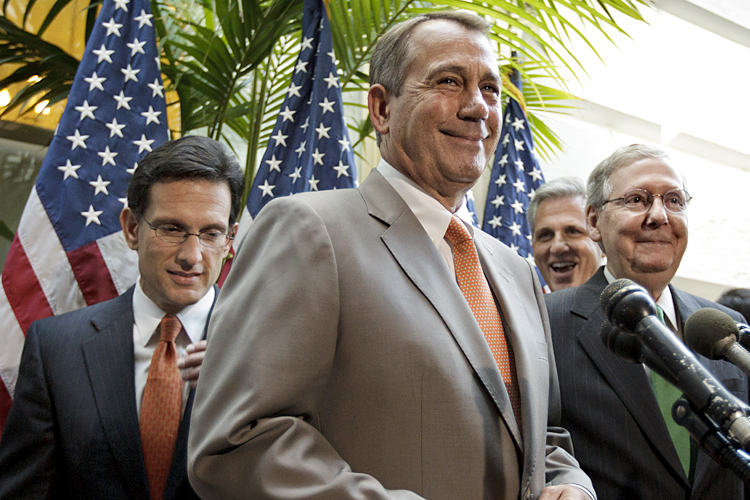
GOP's massive new lie: The truth about Obama's second termEric Cantor, John Boehner, Kevin McCarthy, Mitch McConnell (Credit: AP/J. Scott Applewhite)

When President Obama decided to seek authorization to bomb Syria, he didn’t just throw the fate of his plans into the hands of 535 unpredictable members of Congress. He also made himself vulnerable to overblown suggestions that his entire second term is on the line.

Political reporters have a weakness for narratives, and the narrative of a weakened president is irresistible. Moreover, members of Congress will feed that narrative. Even Democrats. If you’re Nancy Pelosi or Harry Reid, a great way to pad your vote count is to plead to your caucus that if the resolution fails, Obama will become a lame duck a year earlier than he ought to.
This pitch is both morally and factually incorrect.

Let’s assume that absent a divisive, losing debate over striking Syria, Obama would have real potential to accomplish meaningful things before the end of his presidency. An immigration bill, say. It would be perverse for members to accede to acts of war they’d otherwise oppose to salvage an unrelated issue like immigration reform. The moral argument here is the same one that made the “death panel” charge so offensive — making the country’s health systems affordable is a praiseworthy goal, but that doesn’t make killing old people OK.
But the good news for Democratic whips on Capitol Hill is that they don’t need to engage in this kind of manipulation. If the Syria vote goes down, the gloom and doom tales of Obama’s losing gamble will be false.

To the extent that Congress has the will to do anything other than vote on an authorization to strike Syria, the outcome of that vote is disconnected from those other issues. If House Republican leaders believe they and their party have an interest in passing immigration reform or any other issue, they’ll do it no matter how the Syria vote comes down.

The same moral argument works in reverse. If Republicans think an immigration bill should become law, it’s wrong of them to block it because of hard feelings, just as it’s wrong for John Boehner to kill legislation he supports in the abstract for member management purposes, or the self-interest of his own speakership.

Whether the vote to bomb Syria passes or fails, I expect some Republicans will cite it as a key reason when other unrelated issues fizzle. But they’ll be lying. The fight over Syria — like the fights over funding the government and increasing the debt limit — will provide useful cover to Republicans who have already resolved themselves against supporting immigration reform, or a farm bill, or a budget deal, or anything else.

Which brings us to the more depressing point. The idea that Obama will make himself an early lame duck if Congress rejects his request to bomb Syria is more easily belied by the fact that Congress probably isn’t going to do anything else anyhow.

Syria won’t derail Obama’s second term — Republicans will. As New York magazine’s Dan Amira put it, “After losing Syria vote, Obama’s chances of passing agenda through Congress would go from about 0% to approximately 0%. #hugesetback.” That’s an extremely wry way of conveying a depressing truism: Syria won’t derail Obama’s second term — House Republicans will.
Anyone who lends credence to the idea that the Syria debate sealed the fate of issues like immigration reform is giving Republicans a free pass. They have complete agency. And though they’ll attempt to shrink the responsibility that comes with it by connecting the Syria debate to other issues within their control, it’s a ruse nobody should fall for.

So if everything’s disconnected, and each issue creates different incentives, what should we expect when Congress debates Syria? As with almost everything in this Congress, I think a great deal depends on what the Senate does. If the Senate authorization fails, then the House is probably off the hook. If it passes, then I imagine John Boehner will have to rethink his role in the debate: He supports the strike, but isn’t trying to persuade any of his members to join him, and claims responsibility for GOP votes lies with President Obama.
That won’t be a viable position if the fate of the authorization lies in the House and the House only. If Boehner were opposed to striking Syria he could maintain consistency no matter what happens in the Senate. But he doesn’t. And so if the resolution passes the Senate, he’s going to have to ask himself whether he’s comfortable with the idea of it dying in the House, because he, unlike Nancy Pelosi, couldn’t marshal his share of the votes.

Maybe he’s fine with that. Personally, I think it would be the best possible outcome, for Congress, the White House and the country. But then those same narrative-starved reporters will have a new villain if the Assad regime responds to the development, as the administration has suggested, by launching more chemical attacks against the Syrian opposition.

Brian Beutler Brian Beutler is Salon's political writer. Email him at bbeutler@salon.com and follow him on Twitter at @brianbeutler.

Sunday, August 25, 2013

Think Tank Report Says Poor Americans Have It Too Good

Think Tank Report Says Poor Americans Have It Too Good (via Moyers & Company)
Conservative think tanks have spawned a cottage industry churning out dubious studies purporting to show that poor families are living high on the hog on public benefits, a claim that anybody who has actually experienced poverty in America would find…

Tuesday, August 20, 2013

Will the American Right Kill Us All?


 CommonDreams.org


Published on Tuesday, August 20, 2013 by Consortium News


A view of Hurrican Sandy from space. (Image via NASA satellite)


It is a touchstone of the American Right that the Framers drafted the U.S. Constitution in 1787 to tightly constrain the federal government and to promote states’ rights – and that this supposed “originalism” is inviolable regardless of the perceived needs of the nation or the dangers implicit in this so-called “strict construction.”

For various reasons – from the mainstream media’s timidity to the disdain some progressives feel for the Constitution’s compromises on slavery – this right-wing Founding Narrative rarely gets challenged, even though it is a demonstrable fiction. But this lazy tolerance of the Right’s made-up history now is becoming an existential threat to mankind.

That is because the scientific consensus continues to solidify that human activity is causing global temperatures to increase dangerously, possibly causing a catastrophic rise of three feet in sea levels by the end of the century. Yet, right-wing obstructionism, which deems federal environmental activism unconstitutional, has hobbled any effort to enact a timely response to the emergency.

By wallowing in a world of scientific denial and historical fabrication, the Republican Right and its Tea Party allies have prevented the U.S. government from responding aggressively to the existential emergency from global warming
The scope of the impending environmental disaster is fast becoming incontestable among scientists.
“It is extremely likely that human influence on climate caused more than half of the observed increase in global average surface temperature from 1951 to 2010,” a draft report from the Intergovernmental Panel on Climate Change said, according to the New York Times. “There is high confidence that this has warmed the ocean, melted snow and ice, raised global mean sea level and changed some climate extremes in the second half of the 20th century.”

The consequences are expected to grow much worse in the coming decades, with many climate scientists seeing the probability of temperatures rising more than 5 degrees Fahrenheit if the present trend continues, the Times reported.
“Warming the entire planet by 5 degrees Fahrenheit would add a stupendous amount of energy to the climate system,” the Times wrote. “Scientists say the increase would be greater over land and might exceed 10 degrees at the poles. They add that such an increase would lead to widespread melting of land ice, extreme heat waves, difficulty growing food and massive changes in plant and animal life, probably including a wave of extinctions.”

The possibility of a three-foot rise in sea levels would threaten some of the world’s major cities, possibly displacing hundreds of millions of people. The mix of mass dislocations from flooding and the loss of traditional agricultural lands to drought could exacerbate geopolitical tensions and spark warfare among desperate countries facing steep declines in standards of living or even mass starvation.

Given the prevalence of nuclear weapons in the hands of rival nations where the impact of global warming might be particularly severe – from China, India and Pakistan to Great Britain, Israel and the United States – the threat to human existence is made even more acute.

Politicizing Science

Aggressive action by the U.S. government, in particular, is required to avert this impending catastrophe, but today’s Right has politicized the near scientific certainty about global warming and the human role in its acceleration.

From the Tea Party to the “libertarians,” oil money from fossil-fuel energy tycoons, such as Charles and David Koch of Koch Industries, has fueled “populist” propaganda challenging the case for global warming, first by funding “scientists” who quibble with the research or who assert that the warming will be modest and manageable.

Beyond that, America’s political Right has added climate change to its list of perceived “statist” conspiracy theories, claiming that the scientific consensus is just a plot by Al Gore and “liberals” to find another excuse for overriding the supposed constitutional principles of a tightly constrained federal government.

And, since these alleged principles of “originalism” and “strict construction” are inviolable anyway, this thinking goes, there’s no legitimate case that can be made for expanding the federal government’s role in reducing U.S. emissions of the carbon dioxide and other global-warming chemicals.

That is why the emotional pull of the Right’s proclaimed Founding Principles must be addressed with sound historical research, even if some on the Left find it silly or irrelevant to ponder what Alexander Hamilton, James Madison and George Washington were thinking back in 1787.

It is dangerous to cede the historical reality to well-funded right-wing “historians” who are dispatched back in time by the Koch Brothers and their allies to cherry-pick a few quotes here and there to distort what the key Framers were actually doing with the Constitution, i.e. they were creating a vibrant federal government that would have the flexibility to address the country’s “general Welfare” then and in the future.

The Real Constitution

The historical reality of 1787 was nearly the opposite of how today’s Right portrays it. The Framers of the Constitution were intent on overthrowing a disastrous system from the Articles of Confederation, which had enshrined the 13 original states as “sovereign” and “independent” with the central government deemed only a “league of friendship” and lacking any significant power.

As the young nation descended into squabbling and insolvency in the mid-1780s, the advocates for a strong central government – led by Washington, Madison, Hamilton and Gouverneur Morris (who drafted the famous Preamble) – staged what amounted to a nonviolent coup d’etat against the old structure.

Meeting in secret in Philadelphia – and then circumventing the state legislatures by arranging special ratification conventions – the Framers pushed through a system that made federal law supreme and sought to make the states “subordinately useful,” in the words of James Madison.

This reality was recognized by political leaders who opposed what the Framers of the Constitution were doing. For instance, Pennsylvania delegates on the losing side of the Philadelphia debate explained their opposition, declaring: “We dissent … because the powers vested in Congress by this constitution, must necessarily annihilate and absorb the legislative, executive, and judicial powers of the several states, and produce from their ruins one consolidated government…

“The new government will not be a confederacy of states, as it ought, but one consolidated government, founded upon the destruction of the several governments of the states. … The powers of Congress under the new constitution, are complete and unlimited over the purse and the sword, and are perfectly independent of, and supreme over, the state governments; whose intervention in these great points is entirely destroyed.”

The Pennsylvania dissenters noted that the state sovereignty language from the Articles of Confederation was stripped out of the Constitution and that national sovereignty was implicitly transferred to “We the People of the United States” in the Preamble. They pointed out that the Constitution’s Article Six made federal statutes and treaties “the supreme law of the land.”

“The legislative power vested in Congress … is so unlimited in its nature; may be so comprehensive and boundless [in] its exercise, that this alone would be amply sufficient to annihilate the state governments, and swallow them up in the grand vortex of general empire,” the Pennsylvania dissenters declared.

The Sweeping Powers

Those federal powers, listed in Article One, Section Eight, included “to provide for the common Defense and general Welfare of the United States” and “To make all Laws which shall be necessary and proper for carrying into Execution the foregoing Powers, and all other Powers vested by this Constitution in the Government of the United States.”

In other words, the Framers gave the U.S. Congress broad powers to act on behalf of the American people. But those powers were particularly unnerving to Southern Anti-Federalists, such as Virginia’s Patrick Henry, who warned the state’s plantation aristocracy that ratification would inexorably lead to the demise of slavery. “They’ll free your niggers!” Henry declared.

Despite losing the battle to block ratification, the Anti-Federalists did not go away. Behind the charismatic figure of Thomas Jefferson – and drawing important support from Southern slaveholders who feared federal encroachment on their investment in human chattel – the opponents of a strong central government set out to redefine what the Constitution meant. [See Consortiumnews.com’s “Rethinking Thomas Jefferson.”]

That was a political struggle that Jefferson and other Southern slaveholders won against the Federalists of Washington, Hamilton and Morris by the end of the 1790s, with Jefferson’s defeat of John Adams for the presidency in 1800. The victory of Jefferson’s Republicans, those supposed advocates of human freedom, relied on the extra votes that the Southern states got by counting their slaves as “three-fifths” of a person for the purpose of representation.

As the bitter political warfare of the 1790s played out, Madison was pulled from his original alliance with the Federalists into the political camp of his Virginia neighbor and fellow slaveholder Jefferson. In doing so – in becoming a political representative of Virginia’s plantation system – Madison repudiated many of his earlier constitutional positions.

Jefferson called his election a new “revolution” as he reinterpreted the Constitution to afford very limited power to the federal government and expanded authority for states, even to “nullify” federal law. This revisionist approach amounted to a radical change from what Washington, Hamilton, Morris and the earlier Madison had constructed in Philadelphia.
In other words, Jefferson’s view was not the “original” understanding of the Constitution. Yet, today’s Right pretends it was. Even Jefferson, after becoming the third U.S. President, abandoned his “strict constructionism” when it was useful for him to do so, such as when he and Secretary of State Madison negotiated the Louisiana Purchase in 1803.

The Ongoing Struggle

But the struggle between the original Federalist view of the Constitution and its later hijacking by some of its anti-federal opponents has continued throughout American history, most notably in the South’s resistance to Northern efforts to restrict the spread of slavery into new states and ultimately in the secession of Confederate states after Abraham Lincoln’s election in 1860.

Even after the South’s defeat in the Civil War and the end of slavery, the white Southern aristocracy did not surrender its insistence on a crimped view of the Constitution, often finding allies among the powerful Northern “robber barons” of the late Nineteenth Century and early Twentieth. Both the segregationist Southerners and the laissez-faire capitalists of Wall Street wanted the federal government to keep its nose out of their business.

However, with the Great Depression of the 1930s, President Franklin Roosevelt reached back to the original concept of the Constitution – that the federal government was empowered to act on behalf of “the general Welfare,” a principle embedded both in the Preamble and Article One, Section Eight.

Yet, when this federal activism began to encroach on the South’s racial separation in the 1950s and 1960s, the Right again moved to reassert its revisionist take on the Constitution, that it supposedly enshrined states’ rights as supreme.
Though the Right lost this battle to defend racial segregation – much as the Anti-Federalists lost the fight to block the Constitution – the political struggle was by no means over as Southern whites moved to the Republican Party of Richard Nixon and Ronald Reagan.

With Reagan’s victory in 1980, the stage was set for the ascendance again of right-wing revisionism on the Constitution, with Reagan and his Republican successors, George H.W. Bush and George W. Bush, installing on the U.S. Supreme Court right-wing ideologues who embraced the faux history that right-wing “scholars” had been busy assembling.
These ideological descendants of the South’s slaveholders and the later alliance between the Robber Barons and Jim Crow are now positioned to interpret the Constitution as they see fit. Plus, they have a dedicated political movement in the Tea Party and on the Republican Right that has absorbed the made-up Founding Narrative of why the Constitution was written.

This combination of factors now presents an existential threat to the world because the Right’s distortion of the Framers’ original intent precludes crucial U.S. government action to restrain the spewing of climate-changing chemicals into the atmosphere.

It is a case where history is not just history, it is the future of mankind.

Monday, August 19, 2013

How False History Props Up the Right


CommonDreams.org


Published on Sunday, August 18, 2013 by Consortium News


There is a logical way to think about governance – one that was shared by the key Framers of the U.S. Constitution – that the federal government should have sufficient authority to do what is necessary to fulfill the goals that the document laid out about promoting the general welfare and protecting the nation.

Put differently, the actual “originalist” thinking behind the Constitution was what might be called “pragmatic nationalism,” not what today’s Right tries to pretend it was, an ideological commitment to a tightly constrained federal government hemmed in by a strong system of “states’ rights.”


A Revolutionary War-era banner that has been adopted as an iconic symbol of the Tea Party.

Indeed, the “original” thinking behind the Constitution was almost the opposite of the right-wing canard. The key Framers – George Washington, James Madison, Alexander Hamilton and Gouverneur Morris (who authored the famous Preamble) – all believed that a vibrant federal government was needed to control the squabbling states which had pushed the new country to the brink of disaster under the Articles of Confederation.

In other words, the Right’s modern interpretation of the Founding Principles was not shared by the key Framers of the Constitution. Instead, the Right’s position on the Constitution apes the opposition to the Constitution by the Anti-Federalists, who warned that the new federal structure would subordinate the states to the central government and endanger slavery in the South.

Despite that real history, today’s Right has largely succeeded in distorting the Founding Narrative to convince millions of lightly educated Americans that – by joining with the Tea Party – they are defending the Constitution as the Framers devised it when, in reality, they are channeling the views of those who fiercely opposed the Constitution.

This historical issue is important because as the empirical case for “small government” ideology collapses – amid failures of “supply-side economics,” austerity in the face of recession, “free-market” extremism that let the banks run wild, anti-scientific stances denying global warming, etc. – all the right-wingers have left is this claim they are upholding the Framers’ original vision, an emotional tug on many Tea Partiers who dress up in Revolutionary War costumes and unfurl yellow flags with a coiled snake saying: “Don’t Tread on Me.”

Yet, the reality is that key drafters of the Constitution were staunch advocates of a strong central government invested with all the necessary powers to build a young nation and to protect its hard-won independence. Article One, Section Eight authorized a series of powers, including to “provide for the common Defense and general Welfare of the United States” and “To make all Laws which shall be necessary and proper for carrying into Execution the foregoing Powers.”
In Federalist Paper 44, Madison expounded on what has become known as the “elastic clause,” writing: “No axiom is more clearly established in law, or in reason, than that wherever the power to do a thing is given, every particular power necessary for doing it, is included.”

At the time of the Constitutional Convention, Madison favored even a greater concentration of power in the central government, wanting to give Congress the authority to veto state laws, a proposal that was watered-down into declaring federal statutes the supreme law of the land and giving federal courts the power to judge state laws unconstitutional.

‘They’ll Free Your Niggers!’

So, today’s Tea Partiers, “libertarians” and the Republican Right are not so much descendants of the Framers as they are heirs to the Anti-Federalists who tried to strangle the U.S. Constitution in its cradle. And a principal motive for this fierce opposition was a desire to protect slavery.

Led by pro-slavery Southerners like Patrick Henry and George Mason, the Anti-Federalists warned that the Constitution would concentrate so much power in the federal government that it would lead inexorably to the eradication of slavery.
In battling the Constitution’s ratification in 1788, Patrick Henry warned his fellow Virginians that if they approved the Constitution, it would put their massive capital investment in slaves in jeopardy. Imagining the possibility of a federal tax on slaveholding, Henry declared, “They’ll free your niggers!”

It is a testament to how we have whitewashed U.S. history on the evils of slavery that Patrick Henry is far better known for his declaration before the Revolution, “Give me liberty or give me death!” than his equally pithy warning, “They’ll free your niggers!”
Similarly, George Mason, Henry’s collaborator in trying to scare Virginia’s slaveholders into opposing the Constitution, is recalled as an instigator of the Bill of Rights, rather than as a defender of slavery. A key “freedom” that Henry and Mason fretted about was the “freedom” of plantation owners to possess other human beings as property.

As historians Andrew Burstein and Nancy Isenberg wrote in their 2010 book, Madison and Jefferson, the hot button for Henry and Mason was that “slavery, the source of Virginia’s tremendous wealth, lay politically unprotected.” Besides the worry about how the federal government might tax slave-ownership, there was the fear that the President – as the nation’s commander in chief under the new Constitution – might ‘federalize” the state militias and emancipate the slaves.

“Mason repeated what he had said during the Constitutional Convention: that the new government failed to provide for ‘domestic safety’ if there was no explicit protection for Virginians’ slave property,” Burstein and Isenberg wrote. “Henry called up the by-now-ingrained fear of slave insurrections – the direct result, he believed, of Virginia’s loss of authority over its own militia.”

Madison, a protégé of General Washington and a staunch Federalist at the time, sought to finesse the argument by noting that the Constitution’s drafters in 1787 had capitulated to the South’s insistence on its institution of human enslavement. Though Henry and Mason struck a chord with their slavery-is-in-jeopardy argument, Madison ultimately carried the day, albeit narrowly with Virginia’s convention approving the Constitution on an 89-to-79 vote.

But the Anti-Federalists didn’t disappear. Instead, they organized as a political force to harass, deplete and ultimately destroy the Federalists.

The Rise of Jefferson

In another parallel between the modern Right and the Constitution’s opponents, the Anti-Federalists in the South “posed as plucky populists, even though their ranks included many rich slaveholders,” as historian Ron Chernow noted in his 2004 biography of Alexander Hamilton.

These days, “small-government” conservatives also pose as “plucky populists” though they are funded and promoted by self-interested billionaires like the Koch Brothers and Rupert Murdoch. In both movements, there also has been an undercurrent of racism, pro-slavery then and hostility to the nation’s demographic changes — and African-American president — now.

What the Anti-Federalists needed after their defeat in 1788 was a charismatic leader and they found him when Thomas Jefferson returned from France in 1789. A critic of the Constitution but not an outright opponent, Jefferson couched his resistance to a strong central government in his desire to keep the United States an agriculturally based society with states allowed to nix federal policies if they wished.

Appointed by President George Washington as Secretary of State, Jefferson was quickly at loggerheads with Treasury Secretary Alexander Hamilton who moved energetically to create the framework for an effective federal government that could collect taxes, pay its bills, establish credit and encourage the development of American industries.

Like Washington, Hamilton had experienced through his service in the Continental Army the chaos of the Articles of Confederation and the failure of states to meet their financial commitments to support soldiers in the field.

Born out of wedlock in the West Indies, Hamilton’s early life was one of Dickensian deprivation. Abandoned by his father and losing his mother to illness, the self-taught teen-age Hamilton scratched his way to some success working for a merchant and excelling as a writer. His talents were such that community leaders sent him to school in New York as a charity case.

Amid the rising turmoil of revolutionary America, Hamilton distinguished himself as a passionate advocate for independence and – when war broke out – recruited his college classmates into an artillery unit that performed bravely in the battles around New York. Hamilton’s courage and skills brought him to General Washington’s attention, and the French-speaking Hamilton soon became the Commander-in-Chief’s indispensable aide-de-camp.

Though Lt. Col. Hamilton represented General Washington in high-level contacts with French commanders and American generals, the young officer remained eager to prove himself on the battlefield. Eventually, he convinced Washington to give him a military command and he led the American bayonet charge against the final British redoubt at the battle of Yorktown in 1781.

The First Americans

So, like Washington, Hamilton had developed a uniquely American perspective on the young country, having fought across much of its territory with other young men from various states and backgrounds.

As Chernow wrote in Alexander Hamilton: “People continued to identify their states as their ‘countries,’ and most outside the military had never traveled more than a day’s journey from their homes. But the Revolution itself, especially the Continental Army, had been a potent instrument for fusing the states together and forging an American character.

“Speaking of the effect that the fighting had on him, John Marshall probably spoke for many soldiers when he said, ‘I was confirmed in the habit of considering America as my country and Congress as my government.’ During the war, a sense of national unity seeped imperceptibly into the minds of many American diplomats, administrators, congressmen, and, above all, the nucleus of officers gathered around Washington.”

Washington and Hamilton were among the military veterans who understood, viscerally, the failings of the Articles of Confederation in which “sovereignty” and “independence” were bestowed on the 13 states, causing them to look to their own needs, not those of the country.

As the 1780s wore on – even after Great Britain recognized U.S. independence in 1783 – the grand experiment in overthrowing a King’s dominion and establishing a Republic was in grave danger from the lack of a strong national government.

While Washington and Hamilton grasped this problem, Jefferson, who had returned to Virginia after his work drafting the Declaration of Independence in 1776, continued to view his state as his country. He also avoided any actual fighting for independence, fleeing rather than rallying Virginians to defend Richmond (when it was attacked by a Loyalist army led by Benedict Arnold) and then Charlottesville and Monticello (when they were threatened by the cavalry of Banastre Tarleton).

Jefferson, the coddled son of a wealthy plantation owner, preferred a philosophic or romantic view of revolution, never fully confronting its human horrors and practical challenges. His experience representing the United States in France were marked by both his lavish lifestyle at the fringes of Louis XVI’s court and a blind enthusiasm for the bloody French Revolution.

Neither did he see the realities of America very clearly as he toyed with a vision of a bucolic land of industrious small farmers, somehow blotting out the reality around him of large plantations worked by slaves whose hard labor made possible the comfortable life of Southern gentry and Jefferson’s addiction to luxuries.

As Washington, Hamilton and other Founders contemplated a strong central government, Jefferson mused about whether a national Congress was needed at all. So, his clash with Hamilton carried something of an historical inevitability about it.

Clash over Slavery

The two men differed profoundly over slavery. Having grown up poor on sugar islands of the Caribbean, Hamilton knew and despised slavery. He respected the humanity of African slaves whom he had seen literally worked to death or executed for any signs of resistance.

As Chernow wrote, Hamilton “had expressed an unwavering belief in the genetic equality of blacks and whites – unlike Jefferson, for instance, who regarded blacks as innately inferior.” Indeed, Hamilton may have been the most dedicated abolitionist among the Founders, even more consistently hostile to slavery than were John Adams and Benjamin Franklin.
By contrast, Jefferson delved into the pseudo-science of measuring the skulls of his black slaves to “prove” their inferiority. He also could not tolerate the idea of free blacks living alongside whites in America. By contrast, Hamilton not only considered blacks equal to whites but advocated on behalf of their right to live free in America.

In short, Jefferson was a mass of often ugly contradictions, declaring “all Men are created equal” while insisting that blacks were not; advocating a strictly “limited” federal government as a guarantee of “liberty” while staying silent about how that prescription fit neatly with the desire of his fellow plantation owners to maintain slavery; rejecting the tyranny of government power while making apologies for the mass executions by France’s revolutionary government.

Yet, while Jefferson surely was a hypocrite, he was, without doubt, a political genius. After Jefferson wore out his welcome with President Washington through back-biting attacks on Hamilton, Jefferson left Washington’s three-member Cabinet (Henry Knox was Secretary of War) and began fashioning the first American political party.

Backed by wealthy Southern plantation owners and supported by some opportunistic Northern politicians (like Aaron Burr), Jefferson not only forged his “Republicans” into a potent opposition to the Federalists but devised a system of sophisticated propaganda, including secretly financing newspaper editors to gin up “scandals” to be pinned on Hamilton and the Federalists.

Jefferson also understood the value of personal mythmaking, presenting himself as a humble philosopher who preferred designing Monticello or the Virginian Statehouse over the dirty business of politics. Though he had dressed and behaved like a dandy in Paris, Jefferson attired himself modestly after returning to America, the down-to-earth republican.
As Hamilton and the Federalists muted their opposition to slavery out of concern that the issue could shatter the new constitutional structure, Jefferson and the slaveholders took advantage of that relative silence to depict Washington’s administration and its efforts to put the country on a solid financial footing as favoring economic elites.

As Chernow wrote, “The most damning and hypocritical aristocratic economic system emanated from the most aristocratic southern slaveholders, who deflected attention from their own nefarious deeds by posing as populist champions and assailing the northern financial and mercantile interests aligned with Hamilton.”

So, Jefferson and his Southern-dominated political faction won the image battle. Jefferson and the plantation owners – despite possessing human chattel – were the embattled little guys while the abolitionist Hamilton and his merchant political base were the anti-democratic elitists.

Conspiracy Theories

In a distant echo of today’s Republican conspiracy theories about President Barack Obama, Jefferson and his political allies accused Hamilton and the Federalists of harboring secret sympathies for Great Britain and designs on replacing the Constitution with a monarchy – even though Hamilton had done more than almost anyone to win ratification, including organizing the Federalist Papers to sell the new structure to a skeptical public.

Despite President Washington’s warning against “factions,” Jefferson and his supporters pressed ahead gleefully poisoning the political atmosphere of the young nation – and prompting Hamilton and his side to strike back in kind. Eventually, after building a bureaucratic structure that put the nation’s finances on a firm footing, Hamilton begged Washington for his leave once again and retired to his New York law practice in 1795.

Amid all this partisan acrimony, President Washington and then President John Adams struggled to maneuver the country through a narrow channel to avoid war with Great Britain and then France. With the prospect of war looming, President Adams lured Washington back into government to create a professional military. In turn, Washington insisted that his old aide-de-camp Hamilton be made second-in-command and given the prime day-to-day responsibilities.

But Hamilton’s work establishing an effective military only fed the paranoia of the Jeffersonians about how Hamilton might deploy the Army, possibly fulfilling Patrick Henry’s prophesy that the federal government would overturn slavery. The Federalists also made major mistakes including enactment of the Alien and Sedition Acts, which were aimed at maintaining American neutrality and silencing some of the most belligerent voices, particularly the Jeffersonians who favored siding with France in a European war.

Though Jefferson had been elected Vice President under Adams — by earning the second largest number of votes in 1796 – he secretly conspired against the President’s policies, devising the states’ rights theories of “nullification” and even “secession” while encouraging his paid newspaper editors to savage Adams’s character.

In the early years under the Constitution, Jefferson also drew his Virginian neighbor James Madison into the Jeffersonian camp. As he sought to make a political career amid his fellow slaveholding Virginians, Madison broke with his old allies, Washington and Hamilton.

Madison renounced many of his former pro-federalist positions, joining Jefferson in such unconstitutional theories as “nullification,” the supposed right of a state to reject federal law – the opposite position from where Madison had stood during the Constitutional Convention.

Federalist Crack-up

With Hamilton facing intense personal attacks and with Washington’s death in 1799, Federalist unity began to crack. The curmudgeonly President Adams was estranged from Vice President Jefferson, but he also disliked Hamilton and disapproved of his modern theories about banking and industry.

In 1800, running with New Yorker Aaron Burr, Jefferson was able to snatch the presidency away from Adams – although ironically Jefferson’s winning margin was created by the Constitution’s “Three-Fifths Clause,” which allowed the South to count black slaves as three-fifths of a person for the purpose of representation.

As the third U.S. President, the clever Jefferson solidified his myth as a simple republican, getting rid of a gilded carriage that Adams had bought, sometimes answering the door at the White House himself, and shuffling around in slippers.
On the supposed strict-constructionist principles of republicanism, however, Jefferson behaved more like an imperial president. Though he had disparaged Hamilton’s efforts to build a professional military, Jefferson dispatched Navy ships to attack the Barbary pirates without first seeking congressional approval.

Jefferson’s supposed commitment to a view of the Constitution as limited to the specific powers enumerated in Article One, Section Eight also was cast aside in 1803 when Napoleon offered to sell the Louisiana Territories to the United States. Though the Constitution had no provision for such a purchase, Jefferson and Secretary of State Madison suddenly found new merit in the Constitution’s elastic “necessary and proper” clause.

Jefferson also encouraged selective persecution of troublesome newspaper editors and he dealt harshly with his political rivals. Even out of office, Hamilton remained a bête noire to the Jeffersonians, the target of frequent personal attacks. In 1804, Vice President Burr challenged Hamilton to a duel and – though Hamilton had declared he would not fire on Burr – Burr took aim and killed Hamilton, who was only 49.

With Washington and Hamilton gone, the Federalists slid toward irrelevance, even as their earlier structuring of the U.S. government and its financial system kept the nation prosperous. Further marginalizing the Federalists, Jefferson continued to solidify his political movement, ensuring 24 consecutive years of Virginian control of the White House, with Jefferson followed by James Madison and James Monroe.

The Louisiana Territories also opened up more agricultural land and thus the need for more slaves. The Federalists shrank into a narrow regional party in New England and eventually disappeared, their abolitionist principles and pro-government attitudes suppressed for decades.

With his skill at wrapping the interests of fellow slaveholders in high-blown republican rhetoric, Jefferson more than any Founder put the United States on course for the Civil War. Yet, even today, as more is learned about Jefferson’s racism and his gross hypocrisy (including apparently taking slave girl Sally Hemings as a concubine), he is held in high historical regard (including by some progressives who admire his words while ignoring his deeds). [See Consortiumnews.com’s “Rethinking Thomas Jefferson.”]

Jefferson is an icon to today’s Tea Party and to “libertarians,” who have embraced the post-Constitution version of Madison, too. By hailing these Founders in particular – though Patrick Henry and George Mason also make the Liberty Hall of Fame – the modern Right gives the concepts of “states’ rights” and “strict construction” a gloss of constitutional legitimacy. Conservatives brush aside the fact that the actual Framers, including the earlier Madison, rejected this view. [For details, see Consortiumnews.com’s “The Right’s Dubious Claim to Madison.”]

Why this history is particularly relevant today is that, while the Right’s mythological Constitution may be an historical fiction, it still dominates the imaginations of many Americans. Thus, even as the Right’s policy prescriptions fail in providing for “the general Welfare” – from free-market extremism to austerity in the face of recession to letting 30 million Americans suffer without health insurance – the Tea Partiers are convinced they are doing what’s right because it is what the Framers enshrined in the Founding Document.

If that misconception is shaken, the Right will have nothing left to sell the American people, except perhaps bigotry and nihilism.