FAIR USE NOTICE

FAIR USE NOTICE

A BEAR MARKET ECONOMICS BLOG

OCCUPY POLITICALLY

This site may contain copyrighted material the use of which has not always been specifically authorized by the copyright owner. We are making such material available in an effort to advance understanding of environmental, political, human rights, economic, democracy, scientific, and social justice issues, etc. we believe this constitutes a ‘fair use’ of any such copyrighted material as provided for in section 107 of the US Copyright Law.

In accordance with Title 17 U.S.C. Section 107, the material on this site is distributed without profit to those who have expressed a prior interest in receiving the included information for research and educational purposes. For more information go to: http://www.law.cornell.edu/uscode/17/107.shtml

If you wish to use copyrighted material from this site for purposes of your own that go beyond ‘fair use’, you must obtain permission from the copyright owner.

FAIR USE NOTICE FAIR USE NOTICE: This page may contain copyrighted material the use of which has not been specifically authorized by the copyright owner. This website distributes this material without profit to those who have expressed a prior interest in receiving the included information for scientific, research and educational purposes. We believe this constitutes a fair use of any such copyrighted material as provided for in 17 U.S.C § 107.

Read more at: http://www.etupdates.com/fair-use-notice/#.UpzWQRL3l5M | ET. Updates
FAIR USE NOTICE FAIR USE NOTICE: This page may contain copyrighted material the use of which has not been specifically authorized by the copyright owner. This website distributes this material without profit to those who have expressed a prior interest in receiving the included information for scientific, research and educational purposes. We believe this constitutes a fair use of any such copyrighted material as provided for in 17 U.S.C § 107.

Read more at: http://www.etupdates.com/fair-use-notice/#.UpzWQRL3l5M | ET. Updates

All Blogs licensed under Creative Commons Attribution 3.0

Creative Commons License
This work is licensed under a Creative Commons Attribution 3.0 Unported License.

Thursday, November 6, 2014

Here Are Some Things That Soon-To-Be Iowa Senator Joni Ernst Actually Said


 Huffpost Politics
 

Here Are Some Things That Soon-To-Be Iowa Senator Joni Ernst Actually Said


 Joni Ernst


WASHINGTON -- Voters in Iowa elected Republican Joni Ernst to the U.S. Senate on Tuesday, making her the state's first woman senator.

Ernst, a state senator and lieutenant colonel in the Iowa National Guard, catapulted to stardom during the GOP primary with ads featuring her castrating hogs and pulling a handgun from her purse. The spots also helped Ernst win support from prominent Republicans, including New Jersey Gov. Chris Christie and Sen. Marco Rubio of Florida. The woman who branded herself a "mother, soldier, leader” convinced Republicans she was the party's best chance to turn red a Senate seat held by retiring Democratic Sen. Tom Harkin.

While Ernst propelled herself to victory by painting herself as a Midwestern woman who grew up on a farm, Democrats pointed to questionable statements to claim she's a hard-right conservative, if not a conspiracy theorist.

Agenda 21
While campaigning last November, Ernst backed a right-wing theory that the United Nations' sustainable development plan Agenda 21 is a conspiracy that would enable the government to strip Americans of their freedom and eliminate private property rights.
All of us agreed that Agenda 21 is a horrible idea. One of those implications to Americans, again, going back to what did it does do to the individual family here in the state of Iowa, and what I've seen, the implications that it has here is moving people off of their agricultural land and consolidating them into city centers, and then telling them that you don't have property rights anymore. These are all things that the UN is behind, and it's bad for the United States and bad for families here in the state of Iowa.
[Agenda 21 is a non-binding, voluntarily implemented action plan of the United Nations with regard to sustainable development.[1] It is a product of the UN Conference on Environment and Development (UNCED) held in Rio de Janeiro, Brazil, in 1992. It is an action agenda for the UN, other multilateral organizations, and individual governments around the world that can be executed at local, national, and global levels. The "21" in Agenda 21 refers to the 21st Century. It has been affirmed and modified at subsequent UN conferences. Agenda 21's goal is to help the environment and was agreed at Rio Earth Summit in 1992. Local Agenda 21 is Agenda 21 on a local scale, a saying is "think globally act locally" http://en.wikipedia.org/wiki/Agenda_21]


States Can Nullify Federal Laws
At a forum held by Iowa's Faith & Freedom Coalition in July, Ernst suggested that states can somehow nullify laws passed by the federal government.
You know we have talked about this at the state legislature before, nullification. But, bottom line is, as U.S. senator, why should we be passing laws that the states are considering nullifying? Bottom line: our legislators at the federal level should not be passing those laws. We’re right ... we’ve gone 200-plus years of federal legislators going against the 10th Amendment’s states’ rights. We are way overstepping bounds as federal legislators. So, bottom line, no we should not be passing laws as federal legislators -- as senators or congressman -- that the states would even consider nullifying. Bottom line.
WMDs In Iraq
Ernst told the Des Moines Register's editorial board in May that she believed there were weapons of mass destruction found during the United States' invasion of Iraq. From the Daily Beast:
"We don't know that there were weapons on the ground when we went in," she said, "however, I do have reason to believe there were weapons of mass destruction in Iraq." When a Register reporter quizzed her on what information she has, Ernst said, "My husband served in Saudi Arabia as the Army Central Command sergeant major for a year and that's a hot-button topic in that area."
Ernst later clarified those comments in a statement conceding that there were no WMDs in Iraq, although the country had used them before.
47 Percent Mentality
Audio recorded by Radio Iowa in 2013 revealed that Ernst, like many conservatives, holds a "makers vs. takers" view toward social welfare programs. But as Greg Sargent reported, her comments went further than former GOP presidential candidate Mitt Romney's infamous "47 percent" video.
We’re looking at Obamacare right now. Once we start with those benefits in January, how are we going to get people off of those? It’s exponentially harder to remove people once they’ve already been on those programs ... we rely on government for absolutely everything. And in the years since I was a small girl up until now into my adulthood with children of my own, we have lost a reliance on not only our own families, but so much of what our churches and private organizations used to do. They used to have wonderful food pantries. They used to provide clothing for those that really needed it. But we have gotten away from that. Now we’re at a point where the government will just give away anything.
Climate Change Skeptic
While hardly unique among Republicans, Ernst has claimed she does not possess the scientific knowhow to weigh in on whether humans are causing climate change. But she did chalk it up to "cyclic changes in the weather" during an interview in May.
Yes, we do see climates change, but I have not seen proven proof that it is entirely man-made. I think we do have cyclic changes in weather, and I think that's been throughout the course of history. What impact is man-made. ... but I do think we can educate people to make good choices.
She Really Likes Her Gun
An ad featuring Ernst shooting at a target that is supposed to represent the federal government isn't the first time she has used such a stark metaphor. Speaking at a 2012 NRA event, Ernst said her firearm would help protect her if the government imposes on her rights.
I have a beautiful little Smith & Wesson, 9 millimeter, and it goes with me virtually everywhere. But I do believe in the right to carry, and I believe in the right to defend myself and my family -- whether it’s from an intruder, or whether it’s from the government, should they decide that my rights are no longer important.
Ernst also has suggested that President Barack Obama should be impeached, expressed openness to privatizing Social Security, called for abortion providers to be punished if a fetal personhood bill were passed, and opposed a federal minimum wage hike.

RAWSTORY


Joni Ernst hits a new low for anti-science conservatives: waving off germ theory


04 Nov 2014 at 09:21 ET     


As Tom Boggioni here at Raw Story reported yesterday, Joni Ernst, whose bugfuck wingnuttery has managed to fly mostly under the national radar this election season, hit a shocking new low in terms of conservative science denial: Claiming that disease transmission is a matter of “opinion”, not biological fact. Charles Pierce of Esquire reported his bizarre encounter with her on this:
“With Ebola, we see he’s very hands-off. He’s not leading. He’s not leeeaaading,” she said, drawing out that last word like a conjurer casting a spell. I suggested to her that, well, at that moment, one person in America — Dr. Craig Spencer — had Ebola. Her eyes went hard, like the wheels of a slot machine fastening on tilt.
“Well, you’re the press. That’s your opinion.”
Say what?
“But that’s not an opinion. It’s a fact. Only one person in America has Ebola.”
“But he’s not a leeaader,” Ernst said, again. “What he can do is make sure that all of those agencies are coordinating together and make sure that he is sharing that information with the American people, that he cares about their safety.”
It’s worth pointing out that, like with all other aspects of this ridiculous ebola panic, the racism driving it is fairly obvious. Ernst’s entire argument against Obama is a variation on ugly stereotypes about black people being lazy, except she uses a synonym—”apathetic”—and hopes the rest of us don’t notice. It’s a charge that’s so ridiculous, when applied to a man like Obama, that giving it a moment’s thought makes the racism of it screamingly obvious.

Alas, we live in a society where it’s considered impolite to notice even blatant racism as long as the racist manages to do a half-assed effort at coding it, by using a synonym for the racist thing she’s saying, in this case. But blatantly denying incontrovertible facts, like what ebola is and whether or not it can be diagnosed by “opinion”? Needless to say, if Ernst wins, she’s going to be a regular producer of WTF headlines, giving prior contenders like Louie Gohmert and Michele Bachmann a run for their money.

One more observation: One of the oddest things about midterm elections is how frequently politicians, particularly Republicans, will run on issues that the office they’re vying for has little to no power to deal with. Ernst here is running against Obama, not her actual opponent Bruce Braley. But if she wins, guess what? Obama is still going to be in office. Now, running against him isn’t necessarily illegitimate, if the issues were stuff where her vote could sway policy. But how he’s handling ISIS or whether or not he’s panicking over a non-epidemic to your satisfaction cannot be moved by a vote for Ernst. It is utterly irrelevant.

Monday, October 6, 2014

ALEC is coming to a city block near you


Al Jazeera America

Opinion

 
Spencer Platt / Getty Images

The conservative think tank known for flooding state legislatures with its agenda is starting to think locally


October 6, 2014 6:00PM ET
 
The American Legislative Exchange Council (ALEC) has long made headlines as a conservative policy-sharing network that has pushed an agenda of voter suppression and dismantling of public education at the state level. Now the group, backed by conservative billionaires Charles and David Koch, is going local with its new initiative, the American City County Exchange (ACCE). Soon, city government or county commission policies could be generated at the same right-wing think tank that has attacked environmental protections, attempted to undermine the rights of workers and made it harder for people to vote.

At a time of congressional gridlock and partisan rancor, local policies are easier to come by at the local level, with business and citizen groups coming together to generate solutions to problems such as affordable housing, public transit, open space and good-paying jobs. At the heart of these efforts is the spirit of regional collaboration among people who will have to live with the consequences of policy.

ALEC, with its new project, plans to interrupt that collaborative policymaking process by coming in from the outside with model bills based on an ideological obsession with privatization rather than on local knowledge about what works.

Progress grows local

Some of the most successful, life-improving policies in metro regions involve partnerships among elected officials, private corporations and grass-roots activists. What has made collaboration successful is the fact that stakeholders come together. I saw this firsthand during more than a decade of work in Silicon Valley. There the Silicon Valley Leadership Group (a business consortium) worked with organized labor and community groups to ask for funding for quality public transit and the development of affordable housing. One result of this collaboration was a sales-tax-funded public transit system that is being built to serve all residents of Santa Clara County.

The business community in Silicon Valley also partnered with organized labor around the issue of children’s health care. In 2001 the Santa Clara County government, at the behest of the South Bay Labor Council and local business leaders, set up a combination of property taxes, tobacco taxes and outside grants to fund a universal health care program for all children in the county. Though its funding was shaky at times, the program managed to cover 97 percent of the county’s children, until it became part of California’s Medicaid program in 2013.

ALEC wants to take the same sort of highly ideological agenda that has stunted progress in Washington and state capitals and impose it at the metro level.
Instead of trying to contribute to locally relevant solutions, ALEC’s new project hopes to take local stakeholders out of the equation. It plans to take cookie-cutter bills thought up by corporate lobbyists and try to push them through local government. From its state-level work, ALEC is known for its attacks on environmental protections, its opposition to employees’ rights such as paid sick days and for promoting “stand your ground” gun laws that have been used as legal cover for violence against young unarmed African-American men and women.

Privatization agenda

For city and local governments, ALEC’s primary focus is on privatization. Its new local push through the ACCE wants to “ease the way for corporations to take over local services,” as Jay Riestenberg, an analyst at Common Cause, recently told Bloomberg News.

Conservative think tanks such as the Heritage Foundation and the Cato Institute have long pushed a smaller-government agenda of privatizing government services such as mass transit and utilities. They argue that instead of being run by elected public officials using tax dollars, these vital services should be funded and operated by private corporations in a competitive marketplace.

The problem with this is that privatization locks local government into contracts that remove democratic oversight. While city and county politicians face repercussions at the ballot box if they do not deliver services for their constituents, corporations can take the money and run — often leaving voters with few means to reverse bad decisions when services are compromised.
We have already seen at the state level that the negative consequences of ideologically driven privatization can be profound. For example, in Rhode Island, ALEC was successful in persuading state government to hand over its public employee pension fund to private hedge fund managers. As Matt Taibbi documented in Rolling Stone, the regret now runs deep among state lawmakers, who have seen their state pay out millions in servicing fees to these private hedge funds, while the pension fund — and city services — continue to suffer. “They pretty much took the COLA [cost of living pay raises for public workers] and gave it to a bunch of billionaires,” Providence’s retired firefighter union chief told Taibbi.

At the city level, perhaps the most prominent cautionary tale about privatization is Chicago’s move to sign a 75-year contract with finance company Morgan Stanley for the management of its parking meters. A city audit showed that the deal rested on an undervaluing of the meters and lost the city $1 billion as a result. In addition, Morgan Stanley recently sued the city over lost profit because of the periodic shutting down or moving of meters for street cleaning and city events. Chicago lost that lawsuit, to the tune of another $61 million. This means the city incurs additional cost when it wants to add protected bike lanes and bus routes and enact other interventions that could help reduce carbon emissions. And because the deal with Morgan Stanley is locked in for another 69 years, voters have little recourse. Future generations will suffer from this decision, which was made before they were born. They won’t be able to use their votes to reverse the parking meter fiasco.

“Local politics in America is the purest form of democracy,” Pittsburgh city council member Natalia Rudiak said to The Guardian about the ACCE. “There is no buffer between me and the public. So why would I want the involvement of a third party acting on behalf of a few corporate interests?”

Rudiak’s comment cuts to the core of the matter: ALEC wants to take the same sort of highly ideological agenda that has stunted progress in Washington and state capitals and impose it at the metro level. If Americans let them succeed, we will lose the most promising frontier in democratic policymaking today — local government — along with our communities.

Amy B. Dean is a fellow of the Century Foundation and a principal of ABD Ventures, a consulting firm that works to develop innovative strategies for organizations devoted to social change. She is a co-author, with David Reynolds, of “A New New Deal: How Regional Activism Will Reshape the American Labor Movement.”

The views expressed in this article are the author's own and do not necessarily reflect Al Jazeera America's editorial policy.

Wednesday, September 3, 2014

The 7 strangest libertarian ideas

SALON


The 7 strangest libertarian ideas

"Parents should be allowed to let their kids starve" and other notions that lay bare the ideology's extremism


The 7 strangest libertarian ideasRand and Ron Paul (Credit: AP/Manuel Balce Ceneta/Cliff Owen)
This article originally appeared on AlterNet.
AlterNetFew movements in the United States today harbor stranger political ideas than the self-proclaimed libertarians. The Rand Paul school of libertarianism is at least as far outside the mainstream on the right as, say, a rather doctrinaire old-school form of Marxism/Leninism is on the left. The difference is this: The mainstream media isn’t telling us that we’re in the middle of a “Marxist/Leninist moment.” Leninist politicians aren’t being touted as serious presidential contenders. And all the media chatter we’re hearing about a “Libertarian moment” ignores the very harsh, extreme and sometimes downright ugly ideas that are being disseminated under that banner.
It’s great to have allies like Rand Paul working alongside other Americans to defend our right to privacy, restrain the NSA and reduce the military/industrial complex’s grip on foreign policy. It’s possible to admire their political courage in these areas while at the same time recognize that we may not care for the environment they inhabit.
There’s another reason to challenge libertarians on the extreme nature of their ideology: A number of them seem determined to drive competing ideas out of the free market for ideas—which isn’t very libertarian of them. There has been a concerted effort to marginalize mainstream values and ideas about everything from workers’ rights to the role of government in national life. So by all means, let’s have an open debate. Let’s make sure that all ideas, no matter how unusual they may seem, are welcome for debate and consideration. But let’s not allow any political movement to become a Trojan horse, one which is allowed to have a “moment” without ever telling us what it really represents.
Obviously, not every self-proclaimed libertarian believes these ideas, but libertarianism is a space which nurtures them. Can the Republican Party really succeed by embracing this space? Why does the mainstream media treat libertarian ideas as somehow more legitimate than, say, the social welfare principles which guide Great Britain or Sweden?
Here are seven of modern libertarianism’s strangest and most extreme notions.

1. Parents should be allowed to let their children starve to death. We’re not making this up. From progressive writer Matt Bruenig (via Sean McElwee at Salon) comes this excerpt from libertarian economist Murray Rothbard:
“a parent does not have the right to aggress against his children, but also … should not have a legal obligation to feed, clothe, or educate his children, since such obligations would entail positive acts coerced upon the parent and depriving the parent of his rights. The parent therefore may not murder or mutilate his child, and the law properly outlaws a parent from doing so. But the parent should have the legal right not to feed the child, i.e., to allow it to die.”
Note the repetitive use of the word “it” to describe the child. This linguistic dehumanization of helpless individuals is surprisingly common in libertarian literature. (See Ayn Rand and the young Alan Greenspan for further examples.)
Rothbard is a member of the so-called Austrian School of economics, cofounded the Ludwig von Mises Institute, and is widely admired among libertarians. He continues:
“The law, therefore, may not properly compel the parent to feed a child or to keep it alive. (Again, whether or not a parent has a moral rather than a legally enforceable obligation to keep his child alive is a completely separate question.) This rule allows us to solve such vexing questions as: should a parent have the right to allow a deformed baby to die (e.g., by not feeding it)? The answer is of course yes, following a fortiori from the larger right to allow any baby, whether deformed or not, to die. (Though, as we shall see below, in a libertarian society the existence of a free baby market will bring such “neglect” down to a minimum.)”
In other words, society may have moral values, but it may not impose those values on anyone.
To his credit, Rothbard preaches a form of libertarianism which is internally consistent. That’s a virtue some of his peers in that community lack. But people should understand: this idea isn’t an outlier in the libertarian world. It is, in fact, a logical outgrowth of the philosophy.
2. We must deregulate companies like Uber, even when they cheat. So-called ridesharing services like Lyft and Uber are actually taxi services using unlicensed contractors. They’re heavily promoted by libertarians who tout them as ideal examples of the free market as a counter to bureaucratized, more traditional taxicab services.
We now know that Uber is as ruthless in its anticompetitive tactics as it is hypocritical in its public statements. A recent report from the Verge shows that Uber employees frequently hire drivers from competitor Lyft for short, relatively unprofitable rides in an attempt to recruit them. Uber promised to “tone down” these tactics. Instead, in a related move, its employees made and then canceled 5,493 Lyft reservations, reducing the availability of Lyft drivers and hurting its drivers.
Yet here’s what Uber CEO Travis Kalanick had to say about taxis:
“The taxi industry [is] trying to protect a monopoly that has been granted them by local officials, so they’re trying to slow down competition.”
That sounds a lot like what Uber is doing. In a Twitter exchange this week, Kalanick insisted that Lyft drivers were welcome to sign with Uber while keeping their Lyft affiliation. But Uber lied to its own drivers about that recently in New York, when it sent out a text message falsely claiming that New York regulations barred them from signing with Lyft.
Have libertarians expressed their outrage with Uber for its dirty tricks, or for its assault on the idea of competition? Not at all. In fact, libertarian Nick Gillespie wrote in Time last March that, “Letting markets work to find new ways of delivering goods and services isn’t just better for customers in the short term, it’s the only way to unleash the innovation that ultimately propels long-term economic growth.”
Of course, “letting markets work” is precisely what Uber isn’t doing. Gillespie also expresses outrage that California has imposed regulations that include “mandatory criminal-background checks for drivers, licensing via public-utilities commissions, and driver-training programs.”
Which one of those things don’t you want to have in place when a driver comes to your house at four in the morning for an emergency drive to the hospital? But Gillespie equates regulators to “mobsters.”
(Update: Gillespie has been silent about these recent Uber revelations. For its part, Uber has hired former Obama aide David Plouffe, which means nothing politically but will help them leverage their market dominance and suppress competition even more. Expect further radio silence from the libertarian front.)
3. We should eliminate Social Security and Medicare. Libertarian/Republican icon Rand Paulholds with the libertarian faith in his steadfast opposition to both Medicare and Social Security. “The fundamental reason why Medicare is failing is why the Soviet Union failed,” says Paul. “Socialism doesn’t work.”
Except that Medicare isn’t failing. It provides healthcare at lower direct cost, lower administrative cost, and with lower cost inflation than equivalent private-sector insurance. Its biggest efficiency problem stems from the runaway profit motive in the delivery of healthcare. Medicare must purchase goods and services from for-profit medical corporations, hospital chains and pharmaceutical companies. (Conservatives have forbidden it from negotiating prices with Big Pharma.)
In other words: It’s the private sector, not government, which is causing our country’s healthcare problems.
Social Security is entirely self-funded through its own contributions. It has far lower costs than any equivalent private program. Medicare and Social Security annoy libertarians, not because they don’t work, but because they do, putting “free enterprise” in the dust.
4. Society doesn’t have the right to enforce basic justice in public places of business. From Rep. Ron Paul, Sen. Paul’s father:
“… the Civil Rights Act of 1964 did not improve race relations or enhance freedom. Instead, the forced integration dictated by the Civil Rights Act of 1964 increased racial tensions while diminishing individual liberty.”
This was Rep. Paul’s reasoning in voting against a resolution which praised the Civil Rights Act. The libertarian position, as articulated by the Paul family, appears to be this: a business owner’s rights, even in a public place of business, extend to the ability to discriminate solely on the basis of skin color.
That is a violation of the United States Constitution, and of federal law. The libertarian position is that some laws cannot be enforced on private property. But which ones? If the government can’t forbid discrimination, can it forbid theft? Assault? Murder?
As with so many libertarian positions, the reasoning seems murky and the differences appear arbitrary. After all, won’t the free market eventually make a murderer’s business unpopular and force a correction to the killer’s behavior?
5. Selflessness is vile. From libertarian avatar and prophet Ayn Rand: “The man who attempts to live for others is a dependent. He is a parasite in motive and makes parasites of those he serves.”
Aid workers. Doctors Without Borders. Gandhi. Martin Luther King Jr. Mother Teresa. In this libertarian view, all of them are “parasites” who make parasites of those they serve—because, of course, the free market would eventually eliminate poverty. (Never mind the millions who would starve in the meantime.)
Not only are these good people “parasites” in this libertarian view, they are deliberately parasitical (“in motive”). They lack the nobility of character needed to act purely out of self-interest, like the murderer Ayn Rand so admired. As Mark Ames reported in 2012, Rand,
“became enthralled by a real-life American serial killer, William Edward Hickman, whose gruesome, sadistic dismemberment of a 12-year-old girl named Marion Parker in 1927 shocked the nation. Rand filled her early notebooks with worshipful praise of Hickman. According to biographer Jennifer Burn… Rand was so smitten with Hickman that she modeled her first literary creation… on him.”
Rand described the child-killer as a “genuinely beautiful soul.” But that aid worker sweating in the Darfur heat, spooning food into a skeletal child’s mouth? Despicable.
This is not fringe libertarianism. Ayn Rand is its heart and soul.
6. Democracy is unacceptable, especially since we began feeding poor people and allowing women to vote. This isn’t a fringe idea, but one that was proclaimed in a prominent libertarian outlet by one of the movement’s leading funders:
Since 1920, the vast increase in welfare beneficiaries and the extension of the franchise to women — two constituencies that are notoriously tough for libertarians — have rendered the notion of “capitalist democracy” into an oxymoron.
In the face of these realities, one would despair if one limited one’s horizon to the world of politics. I do not despair because I no longer believe that politics encompasses all possible futures of our world. In our time, the great task for libertarians is to find an escape from politics in all its forms — from the totalitarian and fundamentalist catastrophes to the unthinking demos that guides so-called “social democracy.
Translation: Things have gone to hell with all those black and brown poor people around, especially with all those weak-willed women feeling sorry for them and voting to feed them. This isn’t your lunatic uncle talking. These are the words of Peter Thiel, PayPal billionaire and leading libertarian, not spoken in a drunken rage at Thanksgiving dinner, but published in Cato Unbound, perhaps the nation’s leading libertarian outlet.
Thiel clearly felt the heat on this one, since he was forced to append a statement at the end saying, “It would be absurd to suggest that women’s votes will be taken away or that this would solve the political problems that vex us,” adding: “While I don’t think any class of people should be disenfranchised, I have little hope that voting will make things better.”
Thiel’s prescription? “Escape” democracy by using technology to create spaces where the democratic process cannot go. His ideas include ocean colonization, or “seasteading”; outer space; and inevitably, “cyberspace.”
Unfortunately for the libertarian ethos, cyberspace is a government creation. The Internet, and the core technology which enables us to access it, were both created at government expense using government resources. But Thiel’s dream, the libertarian dream, is one in which publicly created tools, which should rightly be considered the modern “commons,” are usurped by a handful of ultra-wealthy individuals for their own undemocratic and noncompetitive purposes.
7. We can replace death with libertarianism. If they can’t bend us to their will in this lifetime, they’ll achieve the goal by other means. Thiel begins his Cato essay this way:
“I remain committed to the faith of my teenage years: to authentic human freedom as a precondition for the highest good. I stand against confiscatory taxes, totalitarian collectives, and the ideology of the inevitability of the death of every individual.”
That’s right. The new libertarian ideology insists that private entrepreneurs will conquer death. Then they’ll force us to bend to their will in the new dominion of eternal life, whether in biochemically preserved flesh or as uploaded spirits in a digital netherworld. Either way, their freedom won’t be ours. Based on their past behavior, they’ll “monetize” our afterlife with advertising and by manipulating our artificial-life experiences.
Life extension has its merits, if handled humanely and justly. But an eternity of “curated content” governed by Silicon Valley billionaires? I’d rather die, thanks very much. And if the Republican Party accepts the “libertarian moment” as its new ideological covering, it apparently has a death wish too.
Richard (RJ) Eskow is a writer and policy analyst. He is a Senior Fellow with the Campaign for America's Future and is host and managing editor of The Zero Hour on We Act Radio.

Monday, September 1, 2014

Why white men hate unions: The South, the new workforce and the GOP war on your self-interest


SALON


Why white men hate unions: The South, the new workforce and the GOP war on your self-interest


Labor & white men once stood united. Now they're across a political divide thanks to decades-long war of confusion


TOPICS: LABOR DAYLABOR UNIONSRAHM EMANUELKAREN LEWISCHICAGO TEACHERS UNIONNAFTABARACK OBAMAMITT ROMNEYUNITED AUTO WORKERSDETROITARCHIE BUNKERRICHARD NIXONSOUTHERN STRATEGYJIMMY HOFFASCOTT WALKEREDITOR'S PICKS,


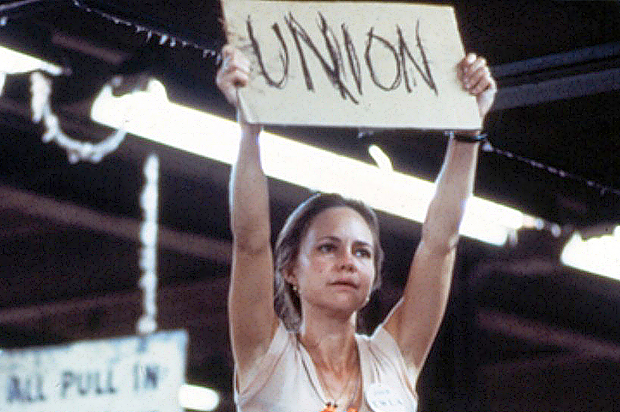
Why white men hate unions: The South, the new workforce and the GOP war on your self-interestEnlargeSally Field in "Norma Rae"

In mid-August, the Chicago Tribune published a poll showing that Karen Lewis, the outspoken president of the Chicago Teachers Union, was leading Rahm Emanuel, 43 percent to 39 percent, in a hypothetical 2015 mayoral race.
Lewis led a 2012 strike after Emanuel tried to impose longer school days with no pay increases (she got her teachers a raise), and vociferously opposed the closing of 50 schools, which were mostly in black neighborhoods. During a pre-strike rally, she called the mayor “a liar and a bully.” Emanuel returned her contempt, shouting “Fuck you, Lewis!” during a tense private meeting. Lewis recently filed papers to raise money for a possible run against the man she labeled “the murder mayor,” because of Chicago’s high crime rate, and she has a pledge of $1 million from the American Federation of Teachers.
If Lewis wins, or even mounts a credible campaign, she will become the most prominent labor leader in America. In that role, she’ll be an appropriate successor to John L. Lewis, Jimmy Hoffa and Walter Reuther, those crusty avatars of mining, trucking and manufacturing. As an African-American, a woman and a professional (she has a sociology degree from Dartmouth), Lewis is the face of the 21st century unionism, which has been transformed from a movement devoted to protecting the safety and livelihoods of blue-collar workers to a stronghold of white-collar liberalism.
Over the past 30 years, labor has been feminized, professionalized, politicized and regionalized. In the 1970s, Archie Bunker, a loading dock foreman, was a staunch unionist. Today, his son-in-law, grad student Mike Stivic, would be the union member.
According to the Bureau of Labor Statistics, the most unionized job category is “education, training and library occupations” at 35.4 percent. That’s a field dominated by women, many with master’s degrees. (In fact, the Center for Economic and Policy Researchpredicts that by 2020, a majority of union members will be women.) Meanwhile, in manufacturing, the macho vocation that gave birth to the modern labor movement, the unionization rate has plummeted from 30 percent in 1983, around the time the term “Rust Belt” entered the popular consciousness, to 9.4 percent today. Workers in manufacturing are now less likely to be unionized than the workforce as a whole. During those three decades of deindustrialization, the United Auto Workers’ membership dropped from 1.2 million to 390,000. That’s mainly due to robots replacing line workers, and the loss of market share to foreign manufacturers. Because when those foreign manufacturers build plants in the United States, they build in the South, a region hostile to unionism.
Earlier this year, the UAW tried to organize a Volkswagen plant in Chattanooga, Tennessee. Despite the tacit support of the company, which needed an independent union to form a European-style works council, the UAW lost the election, 712-626. Before the vote, the anti-union faction, which called itself Southern Momentum, invoked cultural, regional, racial and political resentments to persuade the conservative white men working in the plant that a union was a threat not only to their livelihoods, but to their way of life. Billboards labeled the Democratic-leaning union the United Obama Workers and presented ruin porn images of the derelict Packard Motors plant alongside the slogan, “Detroit: Brought to you by the UAW.” A pamphlet distributed to workers compared the Northern union’s campaign to a campaign by the Union Army in the Civil War: “One hundred and fifty years ago … the people of Tennessee routed such a force in the Battle of Chickamauga.”
(When I heard a Sheet Metal Workers business agent from Syracuse theorize that Southerners dislike unions because “the name reminds them of the Union Army,” I thought he was nuts. Since Chattanooga, I think he may have been on to something. The man’s own local lost most of its members when the Carrier Corp. moved its air-conditioner manufacturing plants to Georgia and Tennessee — and told union employees they weren’t welcome to follow their jobs. Bottom line: If you buy a BMW built in Alabama, or a Toyota built in Mississippi, you’re not helping the American labor movement.)
Contrast that with the UAW’s campaign to organize graduate employees at New York University — exactly the kind of job Mike Stivic would have held. The union won that vote 620-10. It was a gimme. The UAW was dealing with teachers in the most heavily unionized state in the nation. In New York, 23.2 percent of workers belong to a union. In Tennessee, 4.8 percent do. (Only Arkansas, Georgia, Mississippi, North Carolina, South Carolina are less unionized.)
In post-industrial, politically polarized America, it’s easier to organize Northern academics than Southern factory workers. Union membership used to be a matter of economic self-interest, divorced from political or cultural concerns. In the 1960s, union members — who were disproportionately Roman Catholic — could support the New Deal welfare state, while also backing the Vietnam War, racially restrictive housing covenants and bans on abortion and birth control. Richard Nixon — who used to call his ideal voter “a 47-year-old machinist’s wife outside Dayton” — won his 1972 landslide with a “blue-collar strategy” that attracted the support of white male unionists. Many were voting Republican for the first time, out of disgust for the counterculture represented by Nixon’s opponent, George McGovern. They were personified by Archie Bunker, with his strident admiration for “Richard E. Nixon.”
That election was the beginning of a realignment that found the labor movement on the opposite side of a political divide from the white men who once formed the backbone of its membership. Now, support for labor is just another blue state trait, like support for gun control or Obamacare. In states won by Barack Obama in 2012, 13.1 percent of workers belong to a union. In states won by Mitt Romney: 7.2. Collective bargaining is inimical to the conservative ideal of individualism. Unions are “socialist.” In 1983, over half of union members were white men. Now, a little over a third are. In New York City, site of the famous Hard Hat Riot, in which union construction workers attacked students protesting the Kent State shootings, less than a quarter of union members are white men.
It used to be that belonging to a labor union made you a Democrat. Now, being a Democrat is more likely to make you a union member. Blacks are more likely to be unionized than whites. College-educated whites are more likely to be unionized than non-college whites. Public sector employees are more likely to belong to unions than private sector employees. Teachers and librarians vote overwhelmingly Democratic, not because they’re union members, but because the combination of low pay and intellectual inquiry in those professions attracts liberals. And since most union members now work in the public sector, the war on unions has become a front in the larger conservative war on government. (The one exception: cops and firefighters, who have a 34 percent unionization rate. Wisconsin Gov. Scott Walker left them out of his ban on collective bargaining by public employees, because they tend to be white and conservative. Cops and firefighters can’t strike, though, and are more likely to belong to benevolent associations than full-fledged unions.)
Rahm Emanuel has never been a friend of the labor movement. Bill Clinton’s point man on shepherding the North American Free Trade Agreement through Congress, he was a key figure in the Democrats’ realignment from a party of working people to a party of Wall Street, encouraging the party to responded to labor’s weakness by shifting its donor base from unions to socially liberal financiers. Told as White House chief of staff, that tens of thousands of autoworkers could lose their jobs if General Motors and Chrysler didn’t receive a federal bailout, he responded: “Fuck the UAW.”
Emanuel helped vanquish Old Labor as a force in American politics. Now he’s facing the political fight of his life, against a representative of the New Labor that’s taking its place.
Edward McClelland is the author of "Nothin' But Blue Skies: The Heyday, Hard Times and Hopes of America's Industrial Heartland."Follow him on Twitter at @tedmcclelland.

Study Blows The Lid Off The GOP’s Big Lie By Revealing Citizens United Helps Republicans Win

PoliticusUSA


more from Jason Easley
Monday, September, 1st, 2014, 1:46 pm


we-the-corporations-citizens-united


According to a new study, Citizens United is helping Republicans win state legislative elections by increasing their likelihood of victory.

The Washington Post reported on the study,

The advantage isn’t large, but it is statistically significant: The researchers found the ruling, in Citizens United v. FEC, was associated with a six percentage-point increase in the likelihood that a Republican candidate would win a state legislative race.
And in six of the most affected states — Michigan, Minnesota, Montana, North Carolina, Ohio and Tennessee — the probability that a Republican would be elected to a state legislative seat increased by 10 percentage points or more.
In five other states — Colorado, Iowa, Texas, Wisconsin and Wyoming — Republican candidates were seven percentage points more likely to win.
The findings of the study are significant because it debunks the claim of Republicans that Citizens United is not influencing the outcomes of elections. State legislative races are fertile ground for right-wing big spenders because state legislatures have a big influence on policy, and they draw the congressional district maps every ten years.

The wave of voter suppression and anti-choice legislation is coming from Republican run state legislatures that were backed by Citizens United money. The movement to destroy public sector unions is being pushed by the unlimited dark money that was legalized in the Citizens United decision.

The model for what the Koch brothers and other right-wing billionaires and organizations want to do to the federal government can be found in state legislatures all across the country. Republicans and their billionaires haven’t figured out how to make Citizens United money work in Senate and presidential elections yet, but they are working on it.

The Republican claim that the billionaire dollars are just free speech is not true. The millions of ad dollars spent by the right-wing interests in state legislative elections pay immediate dividends. The flood of negative ads gives Republicans a substantial advantage in elections where the Democratic candidate is underfunded and largely unknown.

The threat to our elections and representative democracy is real, and this study shows why repealing Citizens United should be a top priority for Americans who wants their government back.

Study Blows The Lid Off The GOP’s Big Lie By Revealing Citizens United Helps Republicans Win was written by Jason Easley for PoliticusUSA.

© PoliticusUSA, Mon, Sep 1st, 2014 — All Rights Reserved